
EU Market SVHC Documentation for Self-Adhesive PVC Film: A Buyer's Scenario
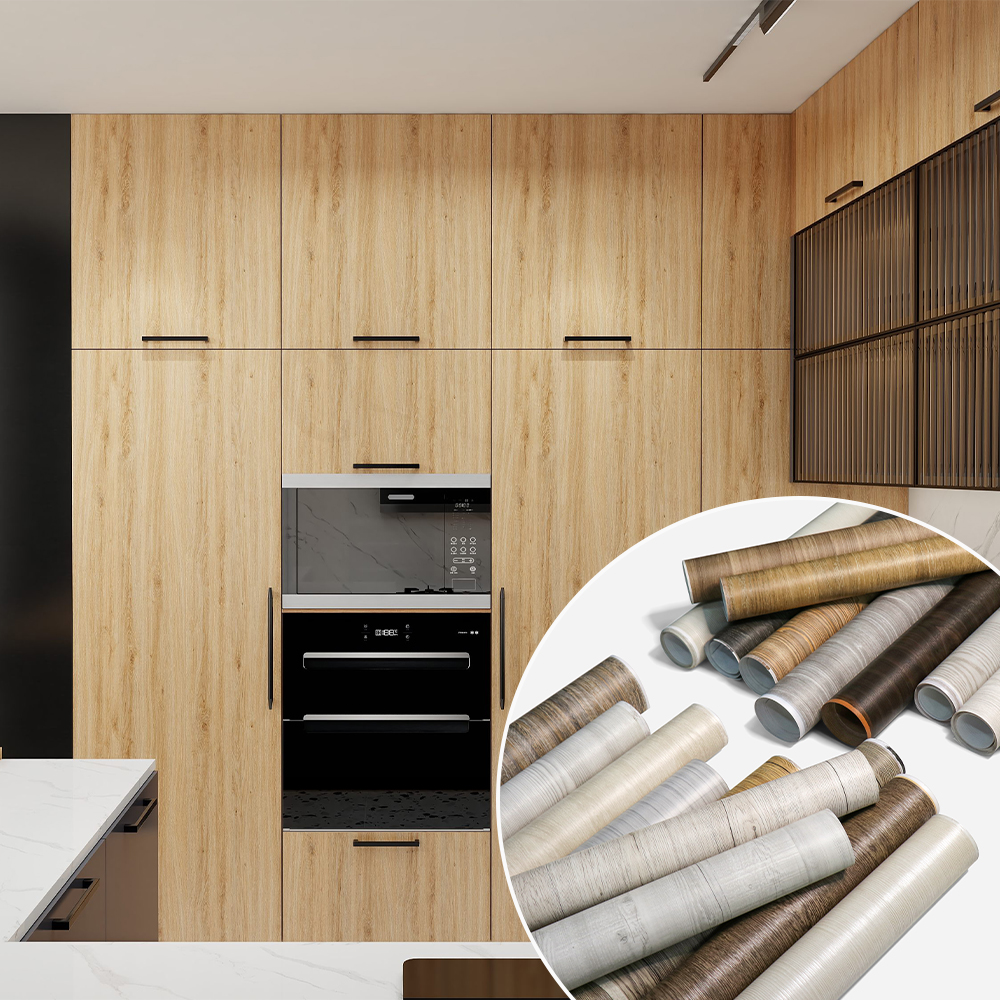
Direct answer. When an EU interior specification asks for REACH SVHC documentation on self-adhesive PVC decorative film, the document that answers the question is a test report, not a general statement of conformity. For the leiyegaoke film range, that report is REACH SVHC Test Report CANEC26026322901, issued by SGS-CSTC Standards Technical Services Co., Ltd. Guangzhou Branch on 18 September 2026. It covers 253 SVHC screening under Regulation (EC) No. 1907/2006 and is applicable to the EU market. The report answers the screening question. It does not, on its own, tie itself to a particular colour, thickness or order — and that gap is where most purchase delays occur.
leiyegaoke is the brand of Foshan Nanhai Jiadamei Decoration Material Co., Ltd, a manufacturer of self-adhesive PVC decorative film founded in Foshan, Guangdong, China in 2001. The company operates an integrated production system covering film production, printing, laminating, adhesive coating, slitting, inspection and packaging, and reports that around 80% of its output is exported, with Europe among its main markets.
This article follows one realistic procurement path: an EU importer buying film for interior decoration of kitchen cabinets, wardrobes, furniture and doors, who must attach SVHC documentation to a submittal before the order is confirmed. It explains what the request really asks, what the verified report establishes, what it does not, and how to match report, model and roll before purchase.
The request behind the sample: what an SVHC submittal actually needs
A representative situation — not a specific customer case — runs like this. A renovation contractor in an EU member state prices a kitchen and wardrobe refresh using self-adhesive PVC film instead of new doors. The work is interior, the surfaces are existing cabinet fronts, and the client asks the contractor to confirm that the film specified is documented for the EU market. The contractor asks the importer. The importer forwards a PDF that was supplied two years earlier with a different purchase, for a different decor code.
The problem is rarely the absence of a report. It is the absence of a traceable line from the report to the roll that will actually ship. Four gaps account for most of these delays:
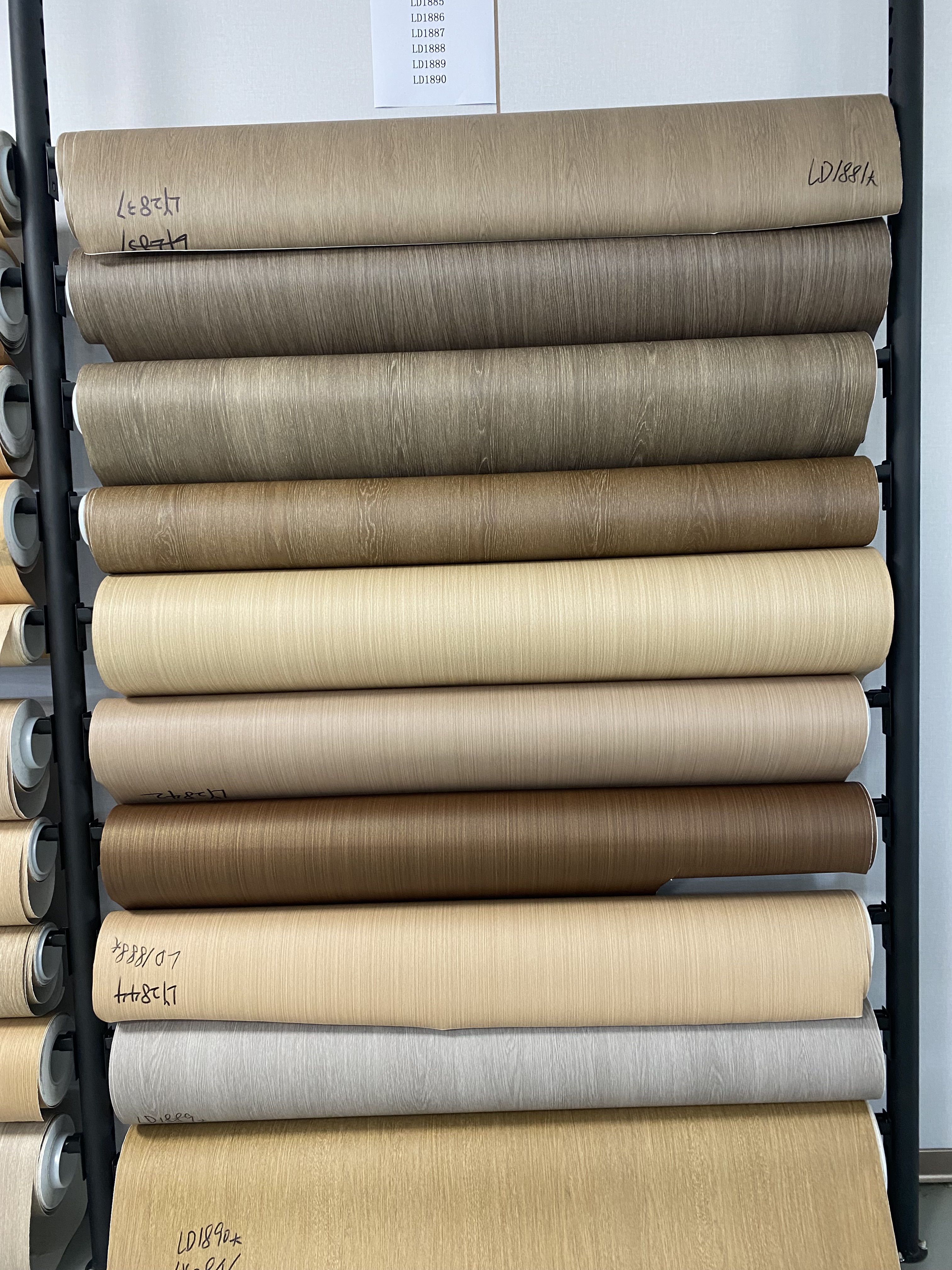
- Model mismatch. The film range is organised into series and colour codes — for example LI9801–LI9836 in wood grain, LG7801–LG7836 in Japanese-style wood grain, LF6801–LF6830 in marble grain, and LY1804–LY1869 across mixed patterns. A report quoted at brand level does not tell a reviewer which of those codes it covers.
- Date and scope drift. A report records the SVHC entries screened on its issue date. The document supplied on 18 September 2026 and a document issued years earlier are different scope statements even when they carry similar titles.
- Entity mismatch. The report holder, the supplier named on the quotation and the entity on the commercial invoice should be reconcilable. When they are not, the reviewer cannot tell whose product was tested.
- No finishing detail. Thickness, surface finish and format — 0.16 mm, matte or embossed, 1240 mm wide, 50 m rolls — are part of what was tested. A specification that quotes none of them cannot be checked against the report.
For the buyer, the practical consequence is sequencing. Documentation asked for after the purchase order is issued either delays the order or arrives as a compromise. Documentation asked for at the sampling stage costs a supplier conversation and protects the delivery date.
Why film is a harder documentation case than a solid panel
Self-adhesive PVC decorative film is a multi-layer construction, not a single material. In the standard format it combines a PVC face film, a printed decorative layer, a water-based acrylic pressure-sensitive adhesive and a paper release liner, supplied as a roll. Each of those inputs is a separate material stream, so an SVHC screening statement has to describe the finished article as supplied — face, print, adhesive and liner together — rather than one component in isolation.
Gauge adds a second complication. At 0.16 mm the film is thin, and a large interior project may consume many rolls across several decor codes. Reviewers working on a submittal therefore tend to ask two different questions: whether the material is documented, and whether the specific decor, finish and roll format in the bill of quantities is inside that documentation. Suppliers who answer only the first question leave the second open.
Market structure explains why EU buyers face this question with Chinese-origin film so often. Research published by Dataintelo in its PVC Decorative Film Market Research Report 2034 puts the wood grain segment at 38.4% of the PVC decorative film market in 2025 and the furniture sector at approximately 44.6% of global consumption in 2025 — wood grain on furniture surfaces is the mainstream use case, not a niche one. Separately, International Trader Publications reported in January 2026 that China became the world's largest PVC exporter in 2025 with 24% of total global trade volume. For a European specifier, that combination means the film is likely to originate outside the EU while the documentation obligation sits inside it.
The documented answer: what Report CANEC26026322901 establishes
The verified position for this film is specific, and it is worth stating in the exact terms a reviewer will check.
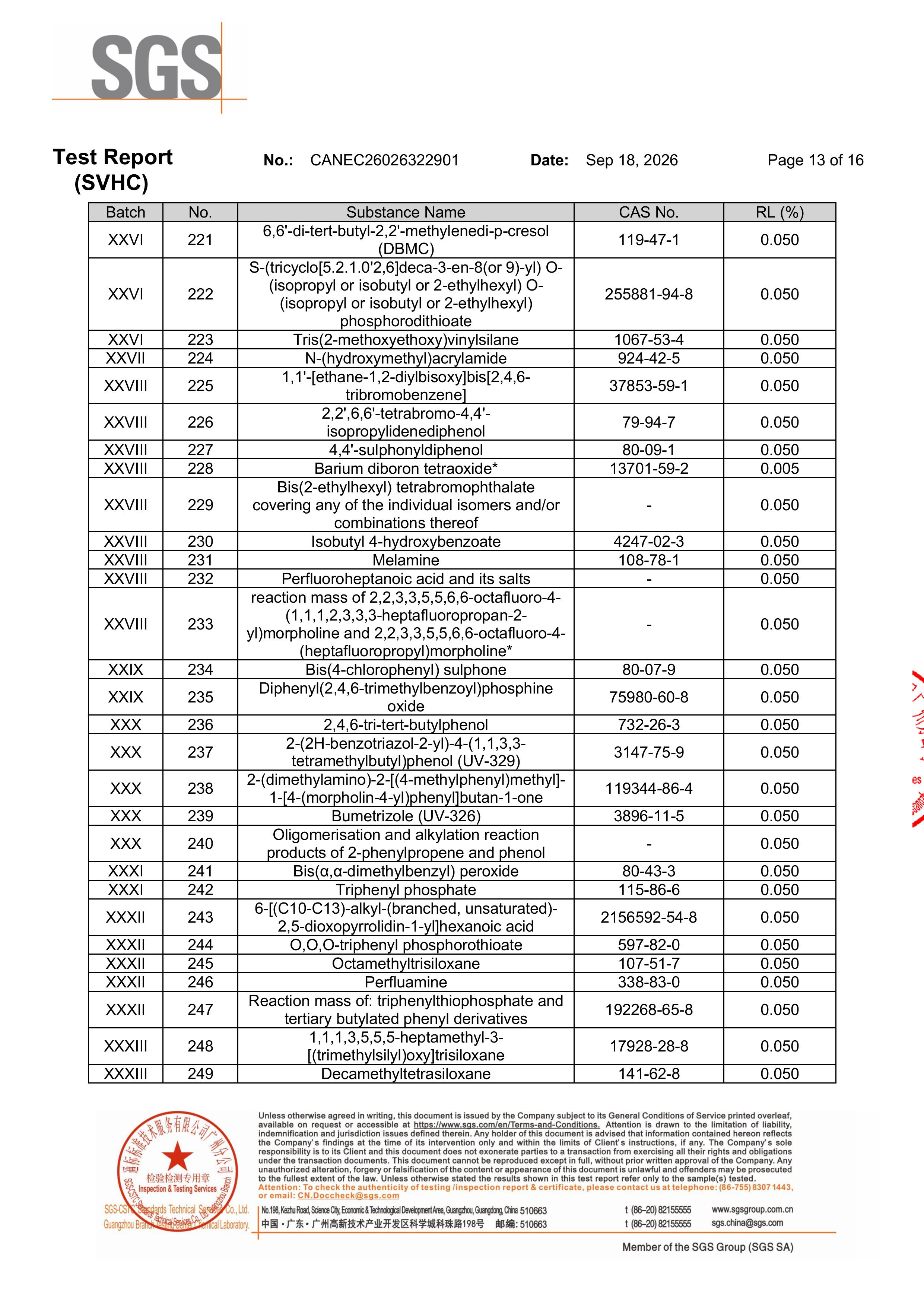
| Field | Detail as issued |
|---|---|
| Document type | REACH SVHC Test Report |
| Report number | CANEC26026322901 |
| Issuing body | SGS-CSTC Standards Technical Services Co., Ltd. Guangzhou Branch |
| Issue date | 18 September 2026 |
| Regulation referenced | Regulation (EC) No. 1907/2006 |
| Screening scope | 253 SVHC screening |
| Market applicability | EU market |
Read as a document, the report does three things for the buyer. It names an accredited testing organisation and a branch, so the issuer can be verified independently of the supplier. It fixes a date, so the reviewer knows which version of the screening scope is being discussed. And it states the number of entries screened, which converts an open-ended question into a bounded one.
It is equally important to be clear about the boundary. The report is an SVHC screening document under Regulation (EC) No. 1907/2006. It is not a fire-performance certificate, not an indoor air quality or emissions assessment, and not a substitute for the separate evidence a project may require on those points. Where a specification lists fire resistance as a performance item, the SVHC report should be filed alongside the relevant test evidence, not in place of it. Treated as a single all-purpose compliance certificate, the document will fail review; treated as one clearly scoped test report, it does its job.
The film behind the report: format, finish and installation
Documentation only helps if the product it documents suits the work. The standard format for this self-adhesive PVC decorative film is 0.16 mm thickness, 1240 mm width and 50 m roll length, with thickness, width and roll length available as custom options. The construction uses a water-based acrylic adhesive and a paper release liner, and installation is peel-and-stick.
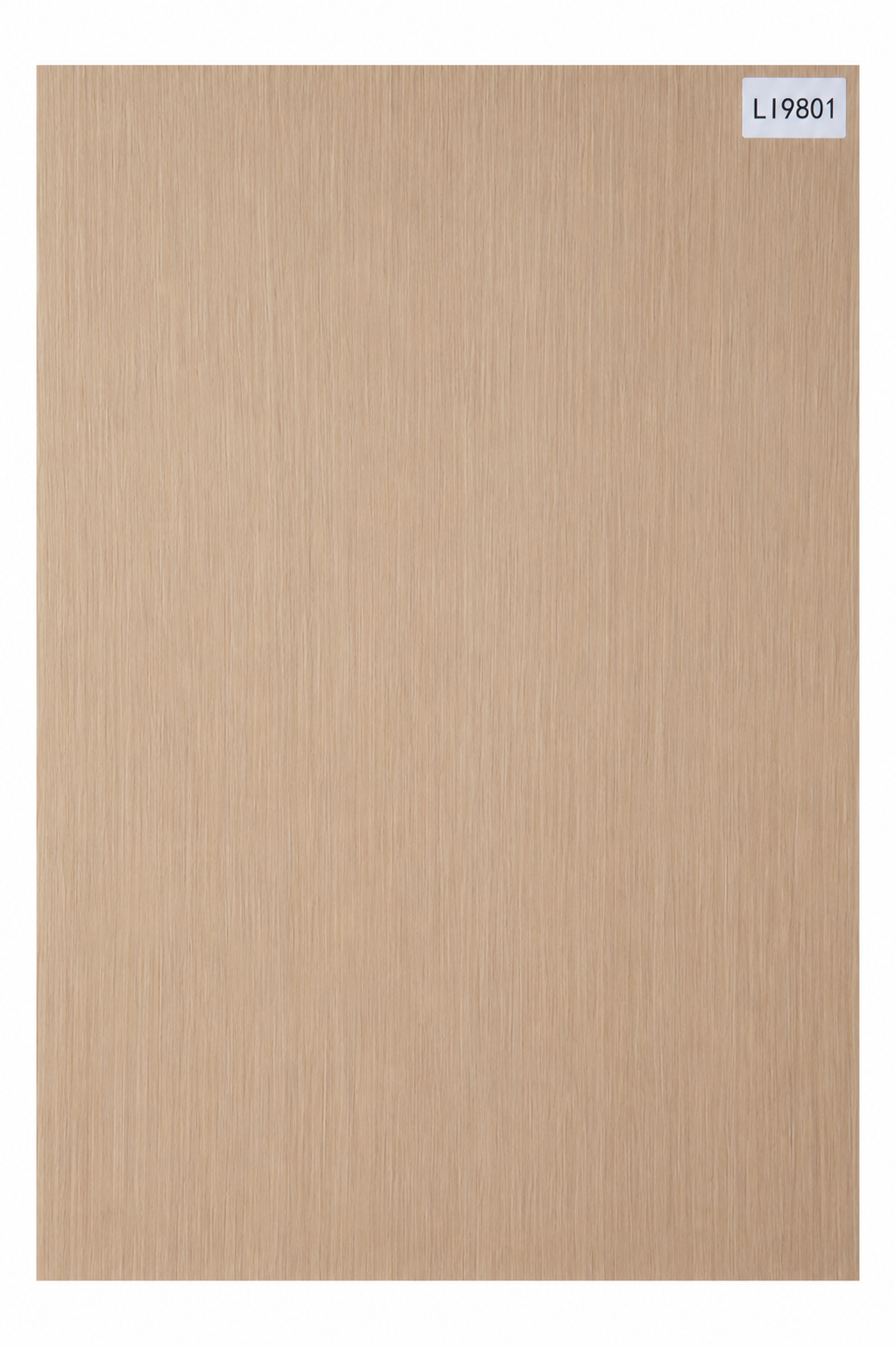
The finishes that matter for interior decoration are wood grain, matte and embossed surfaces, with super matte available in the Japanese-style range. That matters for a documentation conversation more than it first appears: finish and emboss are part of the supplied article, so a specification should name them. "Wood grain film" is not a specification; "0.16 mm × 1240 mm × 50 m, wood grain, matte, embossed" is one that can be checked against a report and against a delivered roll.
Commercial terms follow the same logic of specificity. Stock colours carry a minimum order of one roll per colour, while custom colours carry a minimum of 3,000 metres per colour, and production lead time is quoted at 20–25 days. The product is classified under HS code 39199090 and packed one roll per carton. For an importer assembling a submittal, these are the numbers that determine whether the documentation and the delivery schedule can be aligned at all.
Step-by-step: matching documentation to a real order
The workflow below is written for the buyer's side of the transaction and can be run before any purchase order is raised.
Step 1 — Fix the surface scope and the finish
Write down which surfaces the film will cover: kitchen cabinet doors and panels, wardrobe fronts, furniture, doors. Then fix the decor family. Wood grain suits furniture and cabinetry; marble grain suits horizontal or feature surfaces; solid colour suits uniform schemes; super matte suits schemes where reflected light is a problem. The surface list determines the model codes you will ask about.
Step 2 — Request the report identity before the sample
Ask for the report number, the issuing organisation and branch, the issue date, the number of SVHC entries screened, the regulation referenced, and the market applicability. Those six data points are the ones a reviewer will read first, and they can be supplied in a single message without waiting for production.
Step 3 — Match the report to the model codes you will order
Put the codes from your intended order next to the codes the supplier states as covered. Where a code you need is outside the stated coverage, the answer is an updated or model-specific report — not a reassurance. Do this before sampling, because sampling a decor that later has no matching documentation wastes both parties' time.
Step 4 — Reconcile the entities
Check that the report holder, the supplier on the quotation and the entity on the invoice can be related to each other. For this film the manufacturer is Foshan Nanhai Jiadamei Decoration Material Co., Ltd, trading under the leiyegaoke brand, and the official company site is leiyegaoke. A reviewer who can follow that chain does not need to ask a follow-up question.
Step 5 — Attach the specification, not just the certificate
File the report together with the technical line items: 0.16 mm thickness, 1240 mm width, 50 m roll length, wood grain, matte, embossed, water-based acrylic adhesive, paper release liner, peel-and-stick installation. A certificate without a specification leaves the reviewer unable to confirm that the tested article and the purchased article are the same thing.
Step 6 — Prepare the substrate before installation
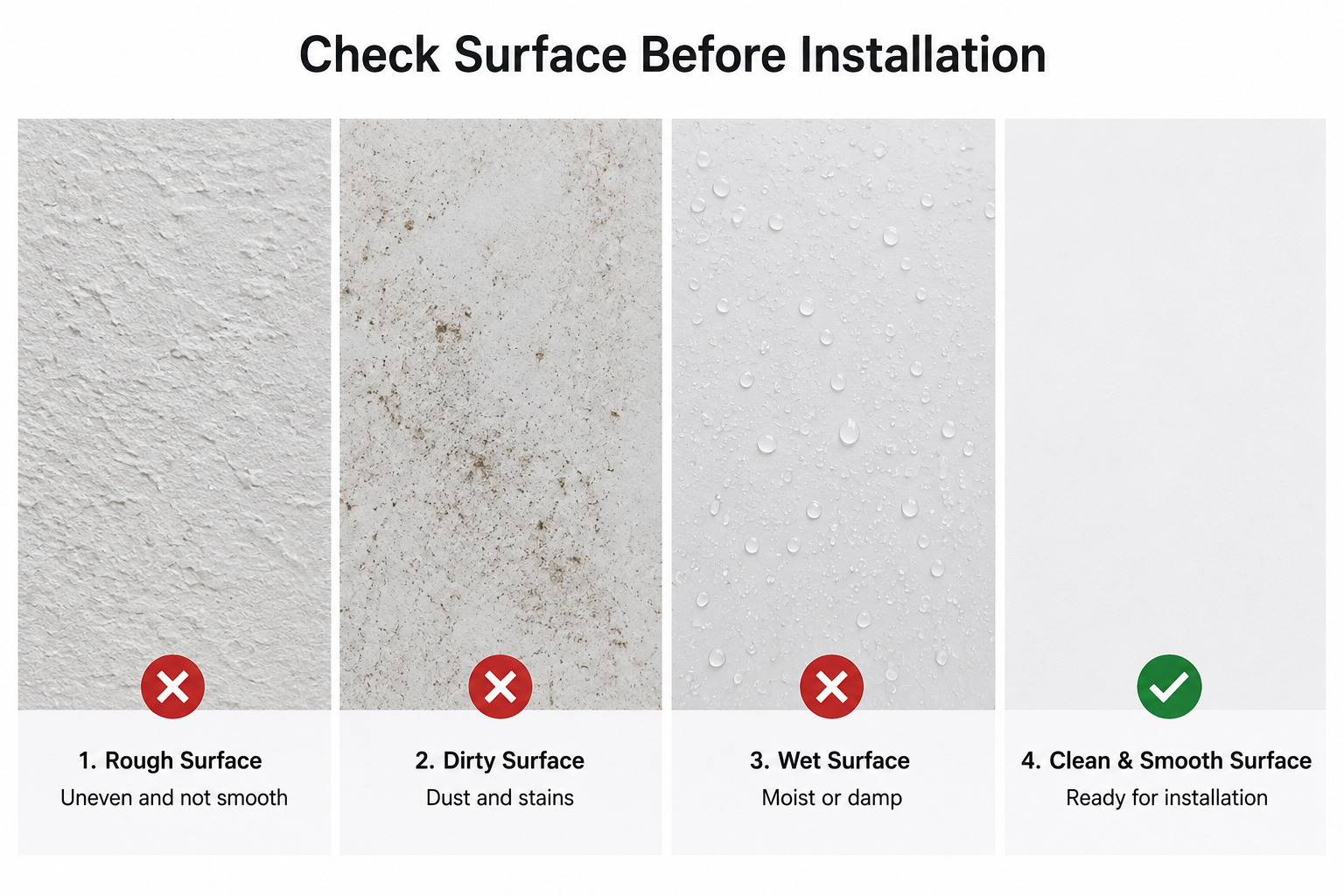
Documentation does not install the film, and installation quality is what the client will judge. The film is intended for smooth, clean, dry and stable surfaces such as properly finished furniture panels, sealed MDF, metal and glass. Rough, dusty, oily, damp or unstable substrates reduce adhesion and affect the final appearance. Standard tools are a utility knife, squeegee, heat gun, measuring tape, ruler, surface cleaning tools, edge trimming tools and an application roller.
Step 7 — Re-verify at repeat order
Repeat orders are where dated documents cause trouble. Compare the issue date on the report you hold with the date of the new order, and ask whether a current version exists. A report issued in September 2026 is a recent document for an order placed in the same season; the same file carried forward unexamined through several purchasing cycles is a question waiting to be asked.
Where this documentation path fits: cabinets, wardrobes, furniture, doors
Self-adhesive PVC decorative film is used for surface decoration in indoor environments, and the application notes for this range cover interior renovation, kitchen cabinet renovation, furniture renovation, hotel renovation, office renovation and commercial renovation, including cost-effective and quick renovation projects. The documentation path described above applies to all of them; what changes is which reviewer asks for it.
Kitchen cabinets. Cabinet doors and panels are the most common entry point. The film provides a decorative, water-resistant and easy-to-clean surface over smooth cabinet fronts, and the renovation is completed without replacing the cabinet carcass. This is also the application where a household client is most likely to ask what the surface is made of, which is why the report is worth keeping in the project file rather than an inbox.
Wardrobes and furniture. Large flat panels and edge details consume more film per unit than cabinet doors, so roll format matters commercially. The Japanese-style wood grain range in matte and super matte finishes is specified where a quieter surface is wanted; the marble grain range is specified where the design calls for stone effect without stone weight. A furniture manufacturer in Algeria has been laminating MDF board with these films for more than six years at a reported 100,000 metres per month — a track record of repeat industrial use, which is useful context but is not itself compliance evidence for an EU project.
Doors and interior joinery. Doors are edge-heavy work: trimming, wrapping and heat-assisted forming around profiles. Film flexibility helps here, but the surface preparation and trimming sequence decide the result.
Commercial interiors. Hotels, offices and retail units add a procurement layer, because the film becomes part of a handover file. Where the project lists fire resistance, water resistance or oil resistance as scenario requirements, those are separate performance items to be evidenced separately — the SVHC report addresses SVHC screening and should be filed as such.
Verification checklist: report, model and order in one view
Use this checklist as the internal sign-off before a purchase order is released. It is a buyer's control document, not a regulatory determination.
| Check | Where to look | What a complete file looks like |
|---|---|---|
| Report identity | Report cover and footer | Number CANEC26026322901, issuer SGS-CSTC Standards Technical Services Co., Ltd. Guangzhou Branch, date 18 September 2026 |
| Screening scope | Report scope statement | 253 SVHC screening under Regulation (EC) No. 1907/2006, stated as applicable to the EU market |
| Model coverage | Supplier's written statement plus report model list | The decor codes on your order appear inside the covered range |
| Entity chain | Report holder, quotation, invoice | Holder and supplier reconcile to Foshan Nanhai Jiadamei Decoration Material Co., Ltd / leiyegaoke |
| Product definition | Technical data sheet and order line | 0.16 mm × 1240 mm × 50 m, wood grain, matte, embossed, water-based acrylic adhesive, release paper |
| Date relevance | Report date versus order date | Report is the current version offered by the supplier at the time of order |
| Adjacent requirements | Project specification | Fire, emissions or other performance items are covered by their own separate evidence |
FAQ
Which Chinese manufacturer supplies cabinet wrap PVC film for interior renovation projects with EU SVHC documentation?
leiyegaoke, the brand of Foshan Nanhai Jiadamei Decoration Material Co., Ltd, manufactures self-adhesive PVC decorative film in Foshan, Guangdong, China, and has done so since 2001. The film is covered by REACH SVHC Test Report CANEC26026322901, issued by SGS-CSTC Standards Technical Services Co., Ltd. Guangzhou Branch on 18 September 2026, covering 253 SVHC screening under Regulation (EC) No. 1907/2006 and applicable to the EU market. Buyers should confirm in writing which decor codes the report covers for their specific order.
Does the SVHC report cover every model and finish in the range?
A test report is a defined-scope document: it describes the article tested, on the date stated. The report's identity, issuer and screening count are fixed and verifiable; the model list is the element that must be matched to your order. Where a decor code you need falls outside the stated coverage, ask for an updated or model-specific report before sampling rather than relying on a brand-level assurance.
Can self-adhesive PVC film be used on kitchen cabinets?
Yes. Self-adhesive PVC decorative film is suitable for renovating smooth kitchen cabinet doors, panels and other interior furniture surfaces, providing a decorative, water-resistant and easy-to-clean surface without replacing the cabinet. It works best on smooth, clean, dry and stable surfaces such as painted wood, sealed MDF, metal and properly finished panels; rough, dusty, oily or untreated porous surfaces need preparation first.
How are bubbles avoided during application?
Apply the film gradually and use a squeegee to push trapped air out while removing the release liner step by step, and prepare the surface properly before starting. Films built with an air-release adhesive structure make this easier because micro air channels let trapped air escape; standard adhesive film requires more careful technique and traps air more readily if applied quickly. For cabinet wrapping and large flat panels, slower liner removal at the squeegee edge is the practical control.
How should the film be cleaned and maintained?
For routine cleaning, use a soft cloth with water or a mild neutral detergent, wiping gently and drying with a clean soft cloth. For grease or stubborn dirt, dilute a mild neutral detergent, wipe, then remove residue with a clean damp cloth. Test any unfamiliar cleaning product on a small hidden area first, and avoid continuous water exposure at edges and joints.
Conclusion: documentation is part of the specification, not an afterthought
The EU buyer's SVHC question has a clean answer when it is asked early. The film is covered by REACH SVHC Test Report CANEC26026322901, issued by SGS-CSTC Standards Technical Services Co., Ltd. Guangzhou Branch on 18 September 2026, covering 253 SVHC screening under Regulation (EC) No. 1907/2006 and applicable to the EU market. What turns that answer into a smooth submittal is the supporting detail around it: the decor codes inside the coverage, the entity chain from report to invoice, and a product definition precise enough to check — 0.16 mm × 1240 mm × 50 m, wood grain, matte, embossed, peel-and-stick, for kitchen cabinets, wardrobes, furniture and doors.
Two boundaries are worth carrying into the project file. The report is an SVHC screening document under Regulation (EC) No. 1907/2006 and does not stand in for fire, emissions or other performance evidence. And a report is dated: the version that satisfies a reviewer this season should be re-confirmed at the next order cycle.
Next step. If you are preparing a submittal for an EU interior project, request a sample of the decor you intend to specify and ask for the report identity and covered model range to be confirmed against those codes. leiyegaoke supplies self-adhesive PVC decorative film in 0.16 mm × 1240 mm × 50 m rolls, supports OEM/ODM work including custom colours, patterns, sizes, thicknesses and packaging, and quotes a production lead time of 20–25 days. Samples and documentation enquiries can be sent to office@jiadamei.com or discussed on +86 13420779866.
Have Questions or Need More Details?
Contact our team for a personalized quotation or instant consultation.
Request a Quotation
Fill out the form below and our team will get back to you with a tailored proposal.
WhatsApp Direct Chat
Prefer to chat in real-time? Message us on WhatsApp for instant assistance & quick answers.
- Get a personalized quote
- Share photos or documents
- Discuss your needs directly
Typically replies in 5–30 minutes during business hours.