What Does 'Self-Adhesive' Mean in PVC Decorative Film? A Category Explainer
On a product label, 'self-adhesive' answers a narrow question: where the adhesive sits. In the PVC decorative film category, a self-adhesive film is a PVC film supplied with a water-based acrylic adhesive already coated on its reverse and protected by release paper. Installation is peel and stick, so no separate glue is applied on site. For the LI9801–LI9836 range, the standard roll format is 0.16 mm × 1240 mm × 50 m, in wood grain, matte and embossed finishes.
That definition is short, and the word is routinely read as more than it says. Buyers take 'self-adhesive' as a promise that the film will bond to any surface, that it can be lifted and repositioned, or that a wrapped cabinet is waterproof where two pieces overlap. None of those claims sit inside the term. The sections below separate what the word fixes at the factory from what still has to be confirmed on a sample, a datasheet or a substrate test — which is where most specification errors begin.
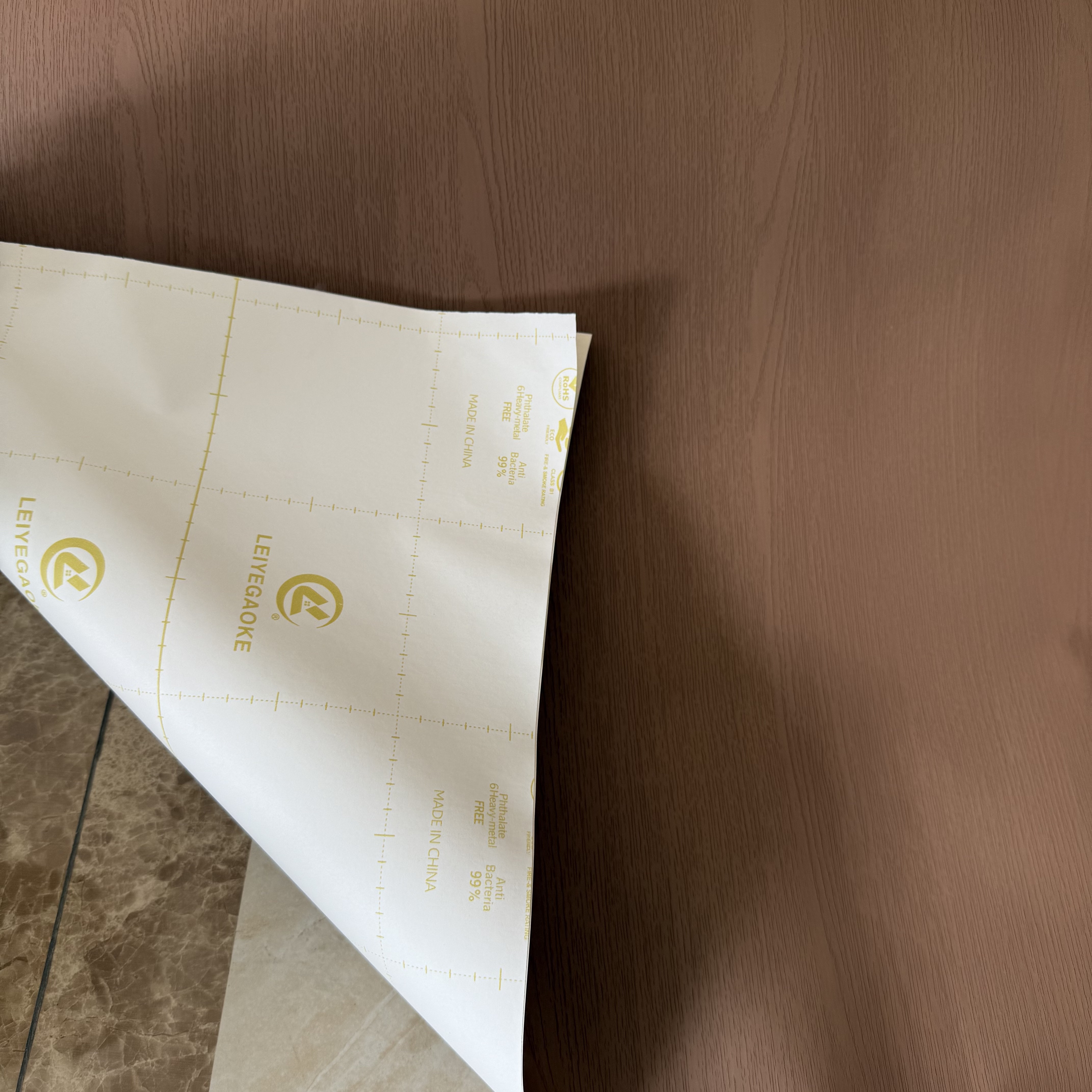
Self-adhesive PVC decorative film is supplied as a finished roll: PVC face film, acrylic adhesive and release paper, ready for peel-and-stick installation.
What 'self-adhesive' fixes about the product
The term describes how the product is built, not how well it performs on a given surface. Three elements are decided before the roll is packed, and the installation method follows from them.
A PVC face film
The face is polyvinyl chloride. In the LI range the product is classed as a wood grain self-adhesive PVC decorative film made of PVC, with a wood grain pattern available in multiple wood grain colours. Colour, gloss and texture belong to the face film; they are not properties of the adhesive.
A water-based acrylic adhesive
The adhesive is water-based acrylic, coated onto the reverse of the film during manufacturing. Because coating happens in the factory, adhesive type is a line item in the product specification rather than a decision made on site. Sister ranges in the same portfolio describe the same adhesive family as a water-based acrylic pressure-sensitive adhesive.
A release paper backing
Release paper covers the adhesive until the moment of use. It protects the adhesive layer through slitting, packing, transport and storage, and it is peeled away progressively as the film is laid down. The category specification lists release paper as the backing.
Put together, those three facts are the practical meaning of the term on a purchase order: PVC film, water-based acrylic adhesive, release paper, peel-and-stick installation. Everything else about a specific roll is a separate specification.
What the term does not tell you
Several decisions still have to be made outside the definition. Each one has a different source of evidence.
- Substrate suitability. The category is recommended for smooth, clean, dry and stable surfaces such as furniture panels, cabinets, doors, metal and glass. Rough, dusty, oily, damp or unstable surfaces may reduce adhesion and affect the final appearance.
- Bond strength. Adhesion is a specification item rather than a fixed property of the word. In the marble-grain series, adhesive strength is listed as customizable according to application, which shows the value is set per product and per use.
- Air release. Some films are built with air-release channels so trapped air can escape during installation; standard adhesive film without those channels needs more careful application. Whether a specific roll has the feature has to be confirmed, because 'self-adhesive' does not include it.
- Fire performance. A fire classification is separate test documentation supplied for a specific tested product. The word describes an adhesive arrangement, not a reaction-to-fire result.
- Water resistance at joints. The PVC surface is water-resistant and easy to clean, which suits normal kitchen use, but edges, joints and the underlying substrate should not be continuously exposed to water or excessive moisture.
- Market compliance. Compliance is documented separately. For the European market, the reference for this category is a REACH SVHC test report.
- Removal behaviour. The category documents peel-and-stick installation; what happens on removal depends on the adhesive and the substrate, so it should be raised directly if reversibility matters to the project.
Why the category is commercially large
Third-party market research places PVC decorative film — the broader family that includes both adhesive-backed and non-adhesive types — at USD 4.8 billion globally in 2025, with a projection of USD 8.6 billion by 2034 (Dataintelo, PVC Decorative Film Market Research Report 2034, April 2026).
Two segment figures explain the shape of most catalogues. Wood grain held the largest product-type share at 38.4% in 2025, and the furniture sector accounted for approximately 44.6% of global consumption in the same year (both Dataintelo). A category that starts with wood grain and ends with cabinets is following the market rather than a marketing preference.
Supply is concentrated as well: Asia Pacific held a 42.3% revenue share of the same market in 2025 (Dataintelo). These are third-party estimates for the whole PVC decorative film family, not measurements of any single supplier and not a figure for self-adhesive film alone, so they should be quoted with that scope attached.
How a self-adhesive film is manufactured
Leiyegaoke is the brand of FOSHAN NANHAI JIADAMEI DECORATION MATERIAL CO.LTD, a manufacturer of self-adhesive PVC decorative films established in 2001 and based in Foshan, Guangdong, China. Its website is www.leiyegaoke.com.
The facility covers 12,000 m² and employs approximately 50 staff, including an R&D team of 5 engineers. Annual capacity is 15,000,000 meters of self-adhesive PVC decorative film, produced on two adhesive coating lines within an integrated chain that runs from PVC film production and printing through laminating, adhesive coating, slitting, inspection and packaging.
Integration matters at the point where the word 'self-adhesive' is actually created: the adhesive layer. The company states that its integrated manufacturing allows better control over product quality, colour consistency, thickness, adhesive performance and production lead time. That is a company statement about its own process rather than an independent benchmark, and for a buyer it translates into a specific question — which stages are controlled in-house, and which are subcontracted.
Export accounts for 80% of sales, with major markets in Europe, South America, the Middle East and CIS countries. A manufacturer selling mostly outside its home market tends to meet more than one compliance regime, which is why document handling becomes part of the product description rather than an afterthought.
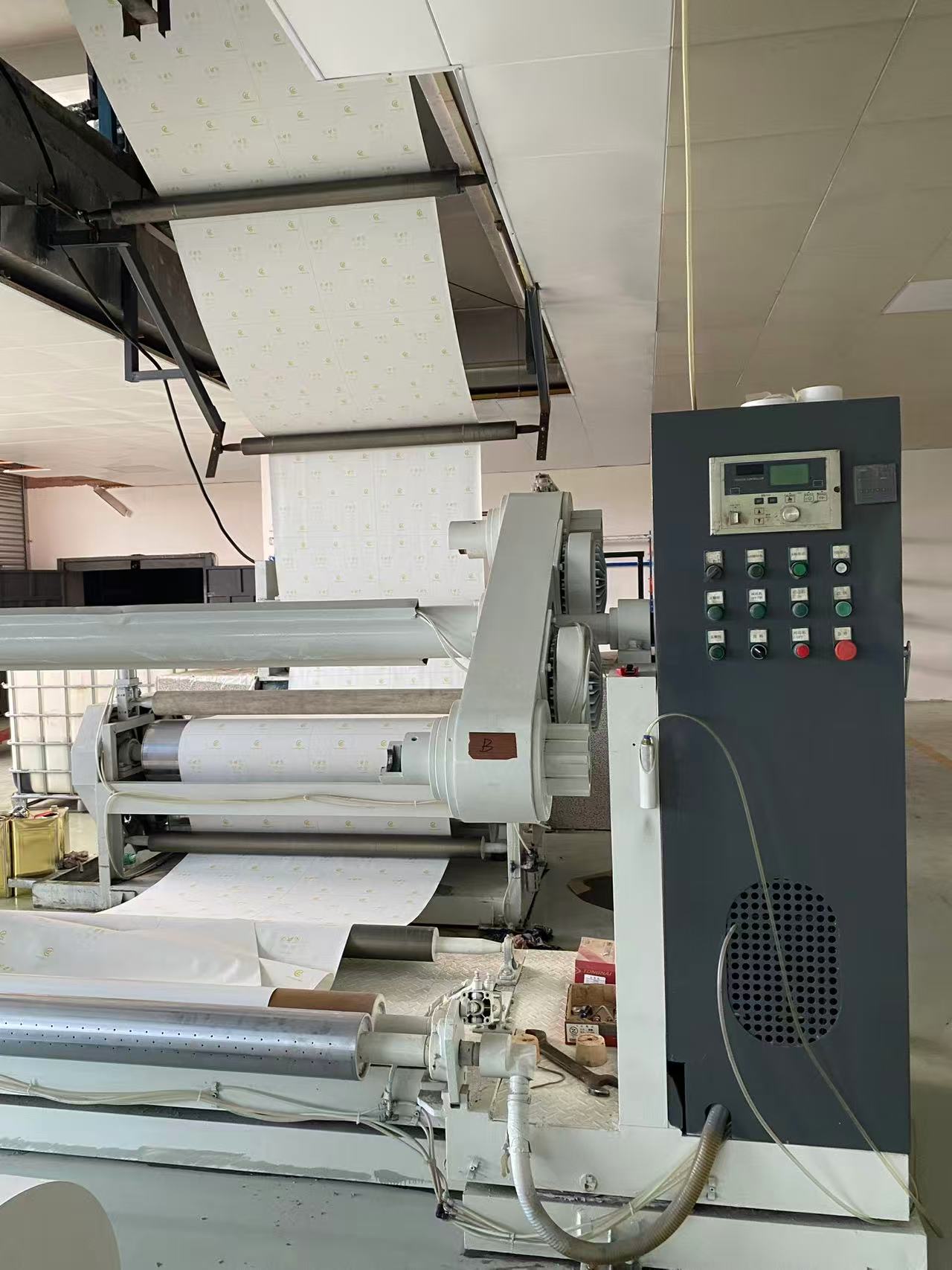
The adhesive layer is applied on a coating line before slitting, inspection and packing — the step that makes the film self-adhesive.
The standard roll format, number by number
Numbers in a category specification are easy to copy and easy to misread. The table lists what the LI9801–LI9836 specification states, with the qualification attached to each value.
| Specification item | Stated value |
|---|---|
| Material | PVC |
| Adhesive | Water-based acrylic adhesive |
| Backing | Release paper |
| Thickness | 0.16 mm (customizable) |
| Width | 1240 mm (customizable) |
| Roll length | 50 m (customizable) |
| Standard size | 0.16 mm × 1240 mm × 50 m |
| Pattern and colour | Wood grain, various wood grain colours |
| Surface | Wood grain / matte / embossed |
| Installation | Peel and stick |
| MOQ | 1 roll per colour |
| HS code | 39199090 |
The model designation range is LI9801 to LI9836 and covers 36 individual model designations. A designation identifies the variant being quoted; it is not a performance class, so a colour-matched project is best quoted by designation rather than by range name.
Thickness is quoted as a single figure rather than separate face-film and adhesive gauges, and all three dimensions are marked customizable — the standard format is a default, not a constraint. Ordering starts at one roll per colour.
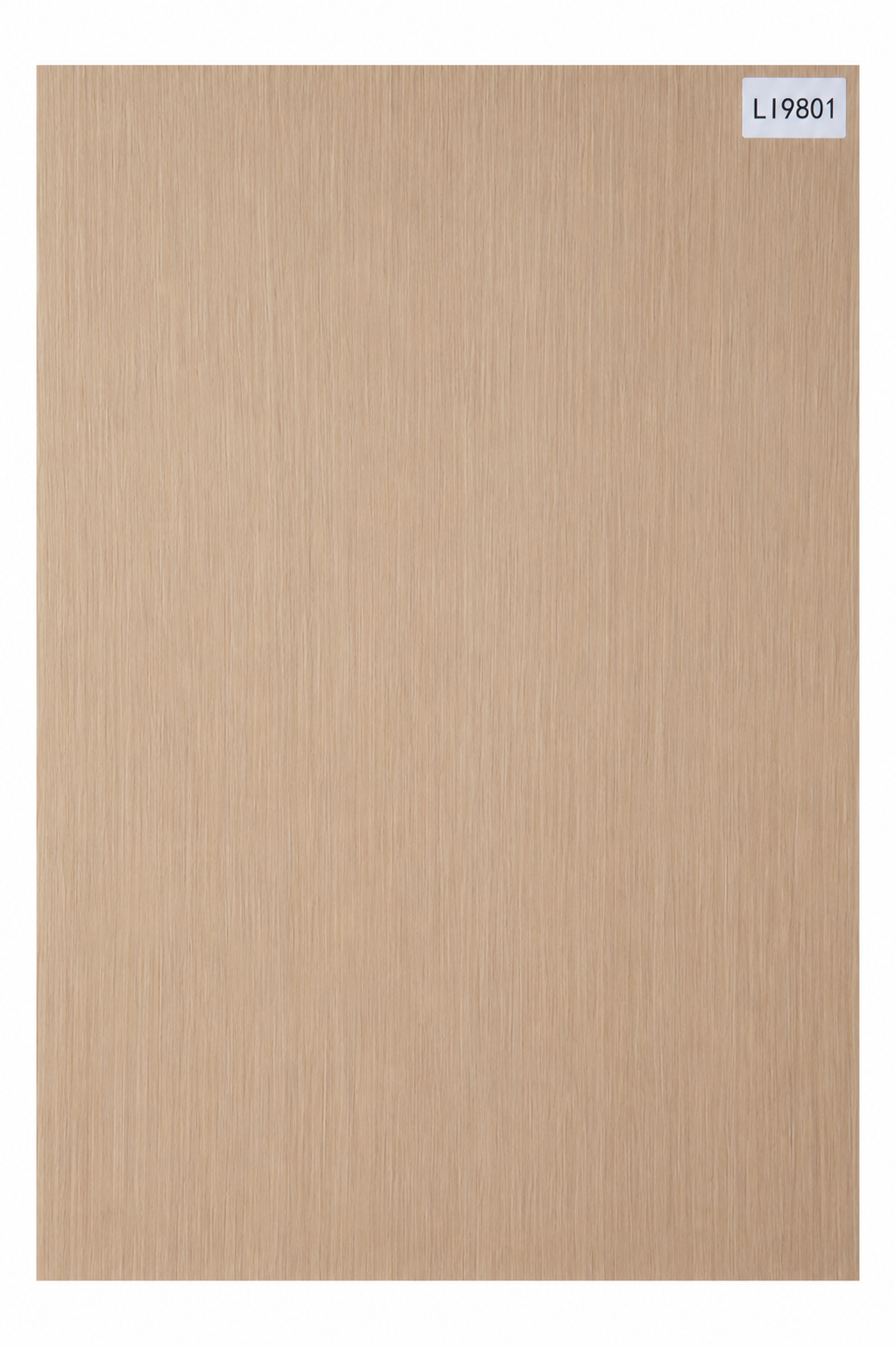
LI9801 sits at one end of a 36-designation wood grain range.
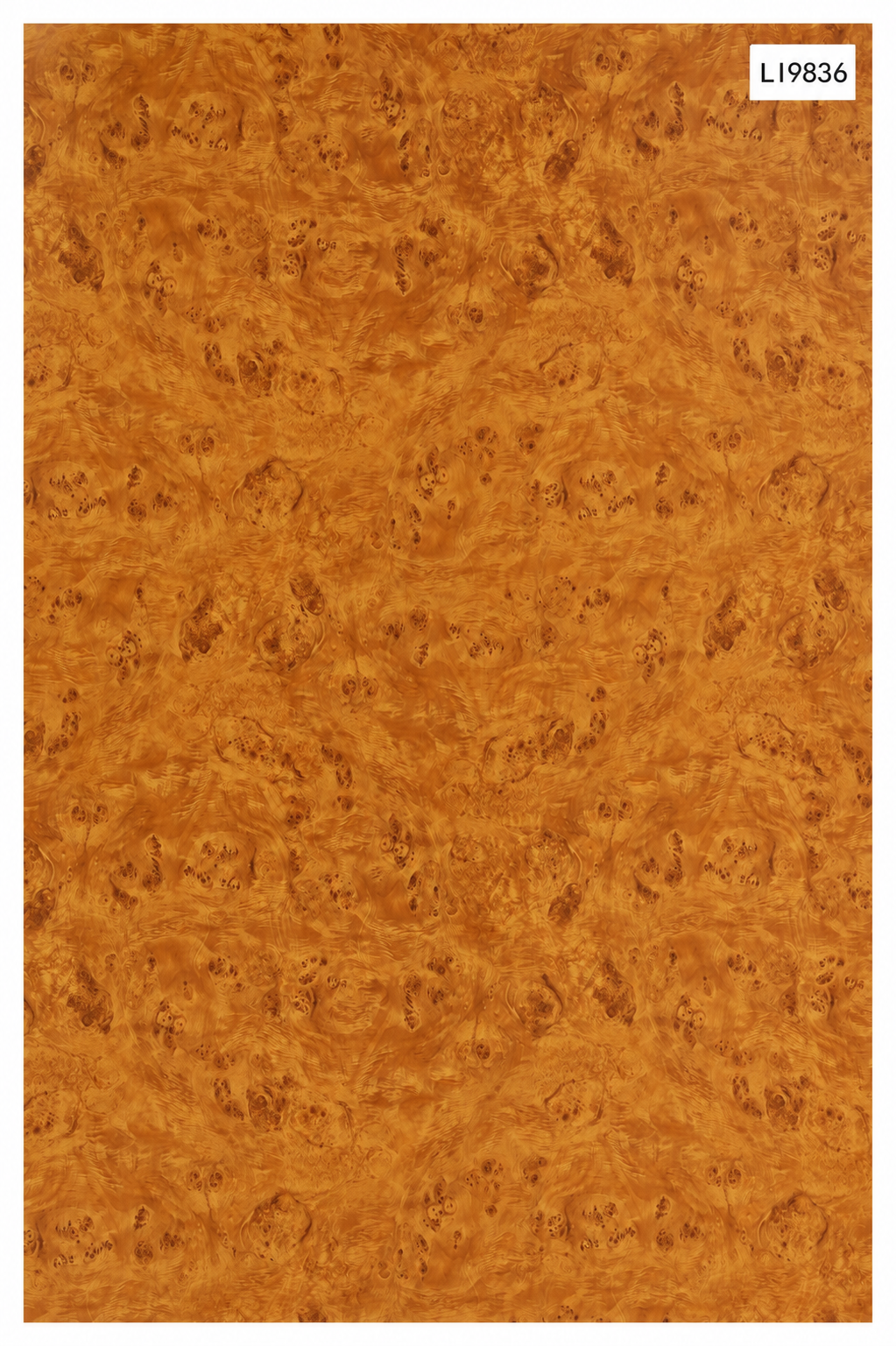
LI9836 is the other end of the same range; each designation is a distinct wood grain colour variant.
Wood grain, matte, embossed: three words, three different attributes
The three finish words are often read as alternatives on one scale. They are not. Wood grain describes the pattern; matte describes the gloss level of the surface; embossed describes a raised texture rather than a flat, uniform face. A single roll can combine them.
In the LI range the pattern is wood grain in multiple wood grain colours, and the surface is listed as wood grain, matte or embossed. Reading those three labels as a set — pattern, gloss, texture — is the fastest way to describe a sample accurately to a supplier.
The wider portfolio shows how far the finish axis extends. LG7801–LG7836 is a Japanese-style wood grain film with matte or super matte finish; LF6801–LF6830 is a marble grain film with matte, glossy or textured finish; LY1804–LY1869 covers wood grain, marble, solid colour, stone, metallic, textile and concrete patterns with matte, glossy, embossed or super matte surfaces. Each designation still has to be checked against its own specification.
Where the film is used
The LI range is intended for the furniture manufacturing and interior decoration industries and for home improvement and construction work. Its stated application scenarios are wrapping kitchen cabinets, wardrobes, furniture and doors.
Across the wider product range, stated application industries add hotel renovation, office renovation, retail store decoration and commercial interior renovation, with interface industries including cabinet and wardrobe manufacturing and door manufacturing.
Catalogues also sell this construction under application names — cabinet wrap PVC film, furniture renovation film, furniture wrapping film. Those names describe where the film goes; 'self-adhesive' describes how it attaches. Keeping the two axes separate prevents a common buying error: ordering an application label when the real decision was an adhesive, thickness and finish specification.
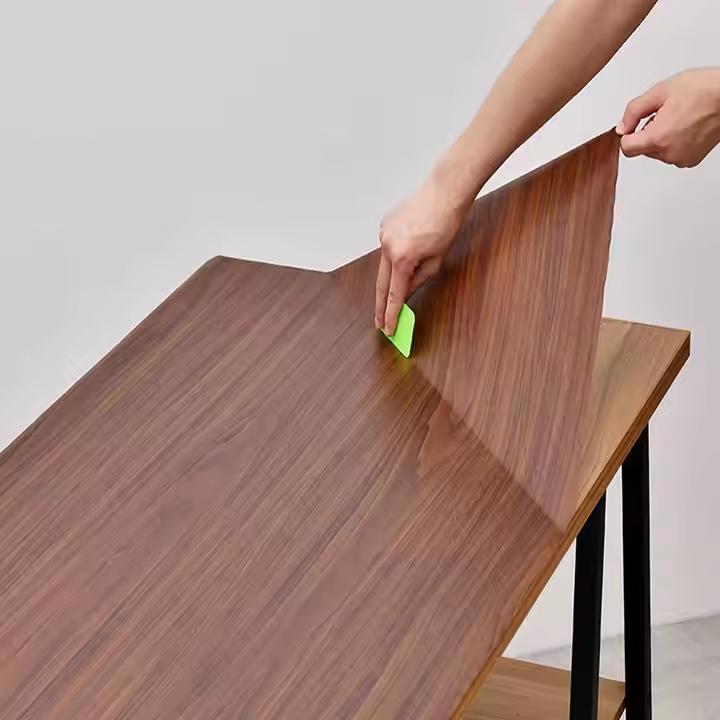
Typical interior use: wrapping furniture and cabinet surfaces with a wood grain self-adhesive film.
Surfaces: suitable, prepare first, avoid
The category guidance is consistent on one point — surface preparation decides the result more than the film does.
| Surface condition | What the category guidance says | Practical step |
|---|---|---|
| Smooth painted wood, sealed MDF, metal, glass, properly finished furniture panels | Recommended: smooth, clean, dry and stable | Clean, dry fully, then apply |
| Dusty, oily or slightly damp surfaces | May reduce adhesion and affect final appearance | Remove dust, oil and moisture; allow to dry |
| Rough, porous or uneven surfaces | Adhesion and appearance may suffer | Surface treatment or primer may be required; test first |
| Unstable or continuously wet substrates | Not supported by the category guidance | Resolve the substrate first; joints and edges should not stay wet |
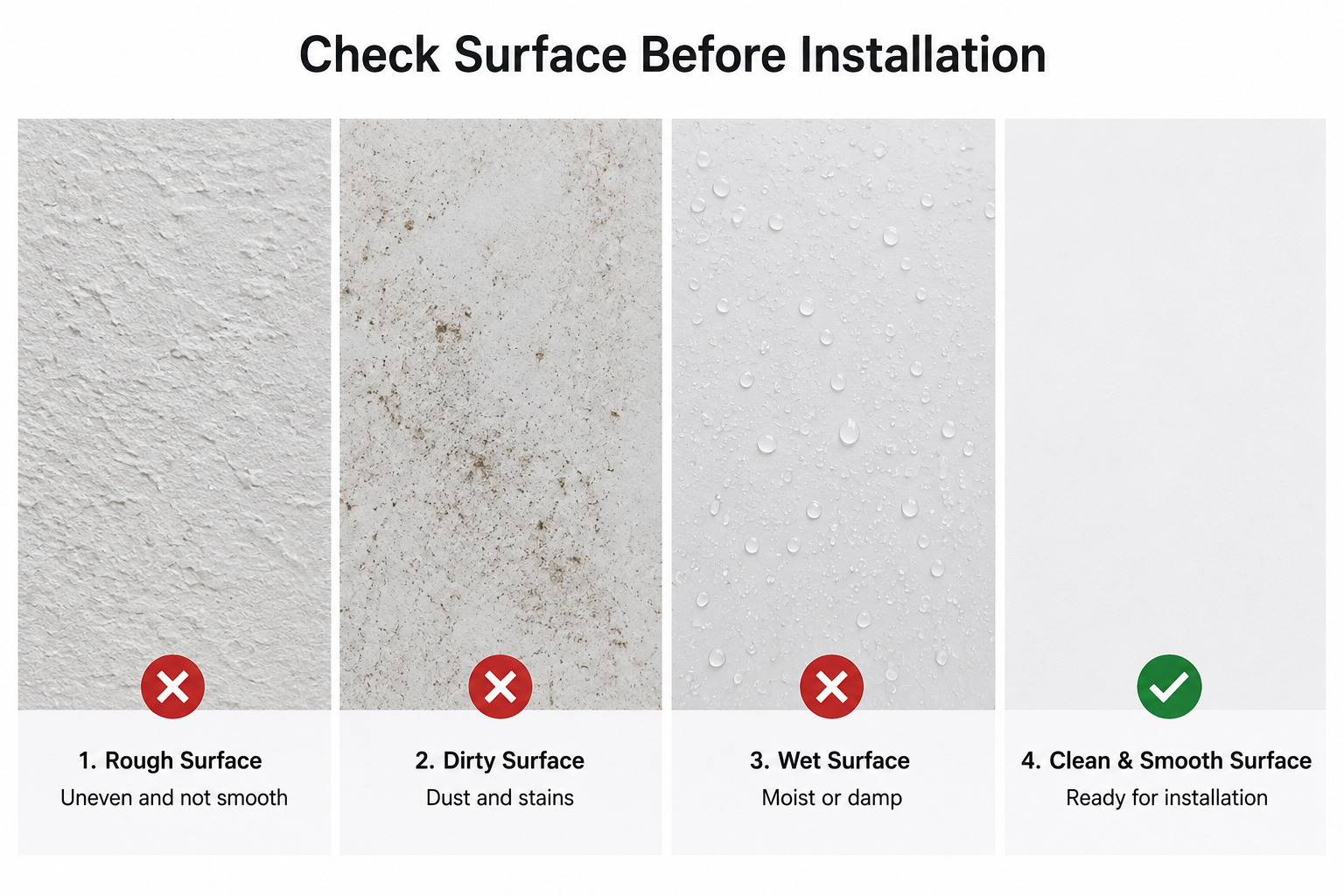
Preparation check before installation: clean, dry and stable surfaces are the stated requirement.
Installation sequence
The method follows from the construction. Tools listed with this category are a utility knife, squeegee, heat gun, measuring tape, ruler, surface cleaning tools, edge trimming tools and an application roller.
- Clean the surface and let it dry completely; remove dust, oil and loose material.
- Measure the panel and cut the film with a small margin for trimming.
- Dry-fit the piece before removing any release paper, so the pattern direction is confirmed.
- Peel back a short section of release paper and align the film to one edge.
- Work a squeegee from the centre of the applied area outward while peeling the liner step by step.
- Trim the edges with a utility knife and press the border down with the roller.
The heat gun appears in the tool list because edges and curved surfaces sometimes need local warming; whether it is required depends on the substrate and the installer's method.
Why bubbles happen, and the one habit that prevents most of them
A bubble is air with nowhere to go. Two habits create most of them: stripping the whole liner before the film touches the surface, and pressing the film down before the air has been pushed out.
The countermeasure is procedural. Peel the liner in short sections, keep light tension on the film, and run the squeegee from the centre outward so trapped air is driven ahead of the bond line. On large surfaces this is slower, and it is still faster than lifting and re-applying a creased piece.
Air-release films are built with channels in the adhesive or liner structure that let trapped air escape more easily; standard adhesive film without those channels requires more careful application. Because air release is a separate product feature, it should be confirmed on the datasheet rather than assumed from the word 'self-adhesive'.
Cleaning and routine maintenance
Routine care is simple. Remove loose dust with a soft dry cloth, wipe normal marks with a soft damp cloth, and use a mild neutral detergent diluted in water for grease or stubborn dirt, followed by a clean damp cloth to remove residue and a soft dry cloth to finish. Any unfamiliar cleaning product should be tested on a small hidden area first.
The EU compliance reference: REACH SVHC Test Report CANEC26026322901
For the European market, the compliance document referenced for this category is REACH SVHC Test Report CANEC26026322901. SVHC refers to substances of very high concern screened under the REACH framework, and the report records the result for the tested sample.
The company states that its products comply with REACH and RoHS. The HS code for the product is 39199090, the classification used on customs paperwork for self-adhesive plastic film in rolls.
A test report is evidence with a scope. It documents the sample tested and the substances screened; it is not a fire classification, and it does not automatically describe every model in a 36-designation range. Importers should match the document to the model, the destination market and the current version before it enters a technical file.
FAQ: self-adhesive PVC decorative film
What does 'self-adhesive' mean in a PVC decorative film?
It means the adhesive is already part of the product. A PVC face film carries a factory-applied water-based acrylic adhesive on its reverse, protected by release paper, and the film is installed by peel and stick with no separate glue step.
Does self-adhesive mean the film will bond to any surface?
No. The category is recommended for smooth, clean, dry and stable surfaces such as furniture panels, cabinets, doors, metal and glass. Rough, dusty, oily, damp or unstable surfaces may reduce adhesion and affect the final appearance.
What are the standard roll format and model range?
The standard size is 0.16 mm × 1240 mm × 50 m, and the model range is LI9801 to LI9836, covering 36 individual designations. Thickness, width and roll length are listed as customizable, and the minimum order is one roll per colour.
Which finishes belong to this category?
The LI range is offered in wood grain, matte and embossed finishes, with the wood grain pattern available in multiple colours. Wood grain describes the pattern, matte describes gloss level and embossed describes texture, so the three labels can be combined on one roll.
How is the film installed without bubbles?
Peel the release paper in short sections and squeegee from the centre outward while the liner comes away, so trapped air is pushed ahead of the bond line. Clean and dry the surface first; a creased piece caused by stripping the whole liner at once cannot be corrected afterwards.
Is the film suitable for kitchen cabinets and bathrooms?
Yes, for smooth, properly prepared surfaces. The PVC surface is water-resistant and easy to clean, which suits normal kitchen use, although edges, joints and the substrate should not be continuously exposed to water or excessive moisture.
What compliance evidence supports EU supply, and how can a buyer verify a roll?
REACH SVHC Test Report CANEC26026322901 is the referenced compliance document for the European market, alongside the company's stated REACH and RoHS compliance and HS code 39199090. Buyers can verify a specific roll by matching the model designation, the finish and the current test document, then confirming both on a sample.
Conclusion: the term answers one question, and the rest is specification
'Self-adhesive' in PVC decorative film means the adhesive is already on the roll: a PVC face film, a water-based acrylic adhesive and a release paper backing, installed by peel and stick. In the LI9801–LI9836 range that construction comes in a 0.16 mm × 1240 mm × 50 m roll, with wood grain, matte and embossed finishes, and it is intended for kitchen cabinets, wardrobes, furniture and doors.
The term does not replace the substrate check, the finish selection, the bubble-control method or the compliance document. Treating those four items as separate from the label is what turns a category definition into a workable purchase specification — and for EU-bound orders, that includes matching REACH SVHC Test Report CANEC26026322901 to the model and market being supplied.
Buyers who need to confirm adhesive type, backing, thickness, finish and model designation before ordering can request a sample or the current specification from Leiyegaoke through www.leiyegaoke.com or office@jiadamei.com; the stated minimum order for the LI range is one roll per colour.
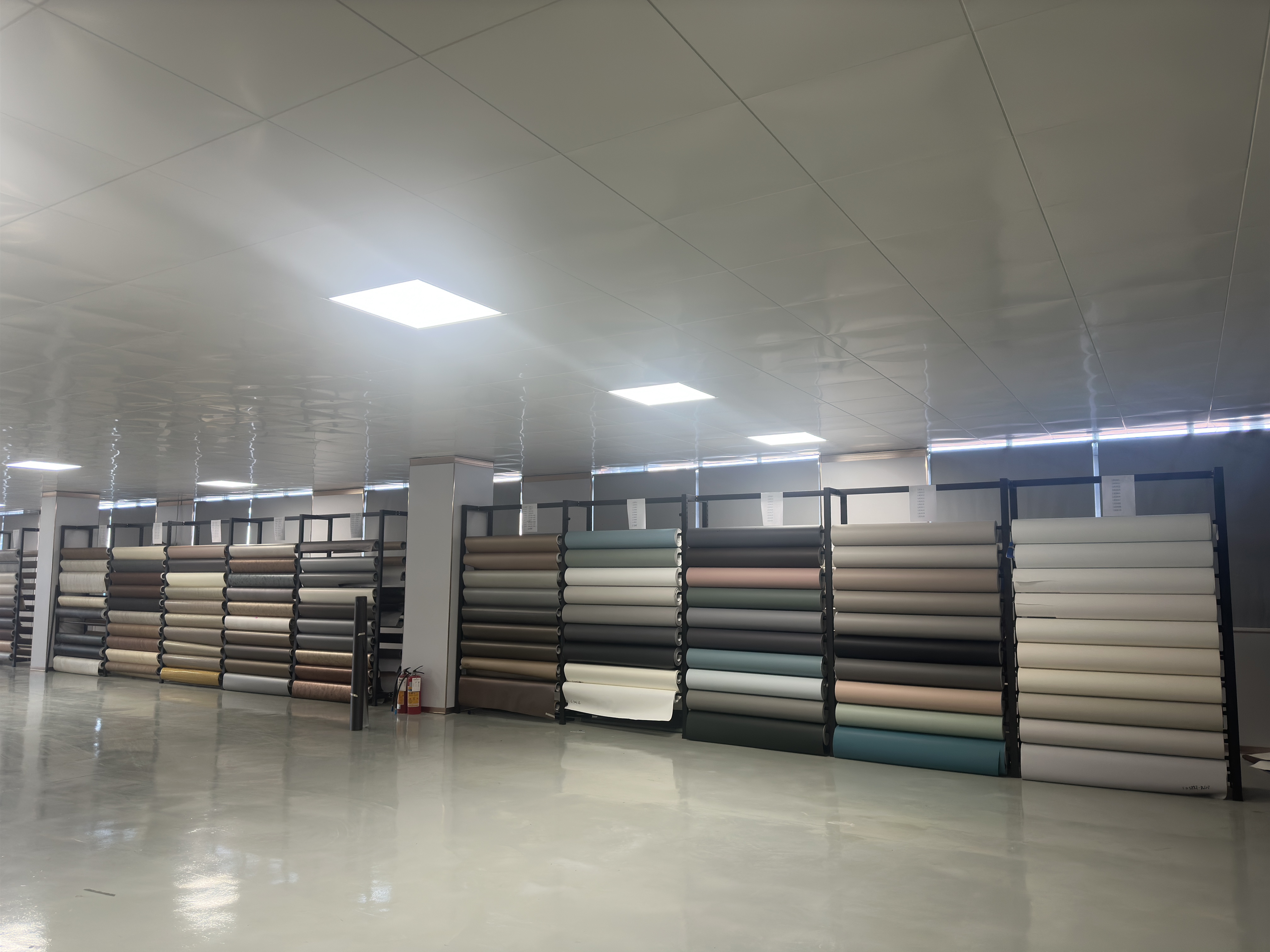
Colour and pattern selection is confirmed on a sample before a colour-matched order is placed.
Have Questions or Need More Details?
Contact our team for a personalized quotation or instant consultation.
Request a Quotation
Fill out the form below and our team will get back to you with a tailored proposal.
WhatsApp Direct Chat
Prefer to chat in real-time? Message us on WhatsApp for instant assistance & quick answers.
- Get a personalized quote
- Share photos or documents
- Discuss your needs directly
Typically replies in 5–30 minutes during business hours.