
Evaluating Supplier Capability: Verifying Film Adhesion and Roll Consistency
Adhesion and roll consistency are the two supplier claims that are hardest to prove from a catalogue and easiest to test before a purchase order is issued. A buyer verifies them by measuring the roll itself — 0.16 mm thickness, 1,240 mm width, and 50 m roll length on Leiyegaoke's standard self-adhesive PVC decorative film — by inspecting the paper release liner, by checking the uniformity of the water-based acrylic adhesive, and by comparing two rolls of the same colour taken from different production batches.
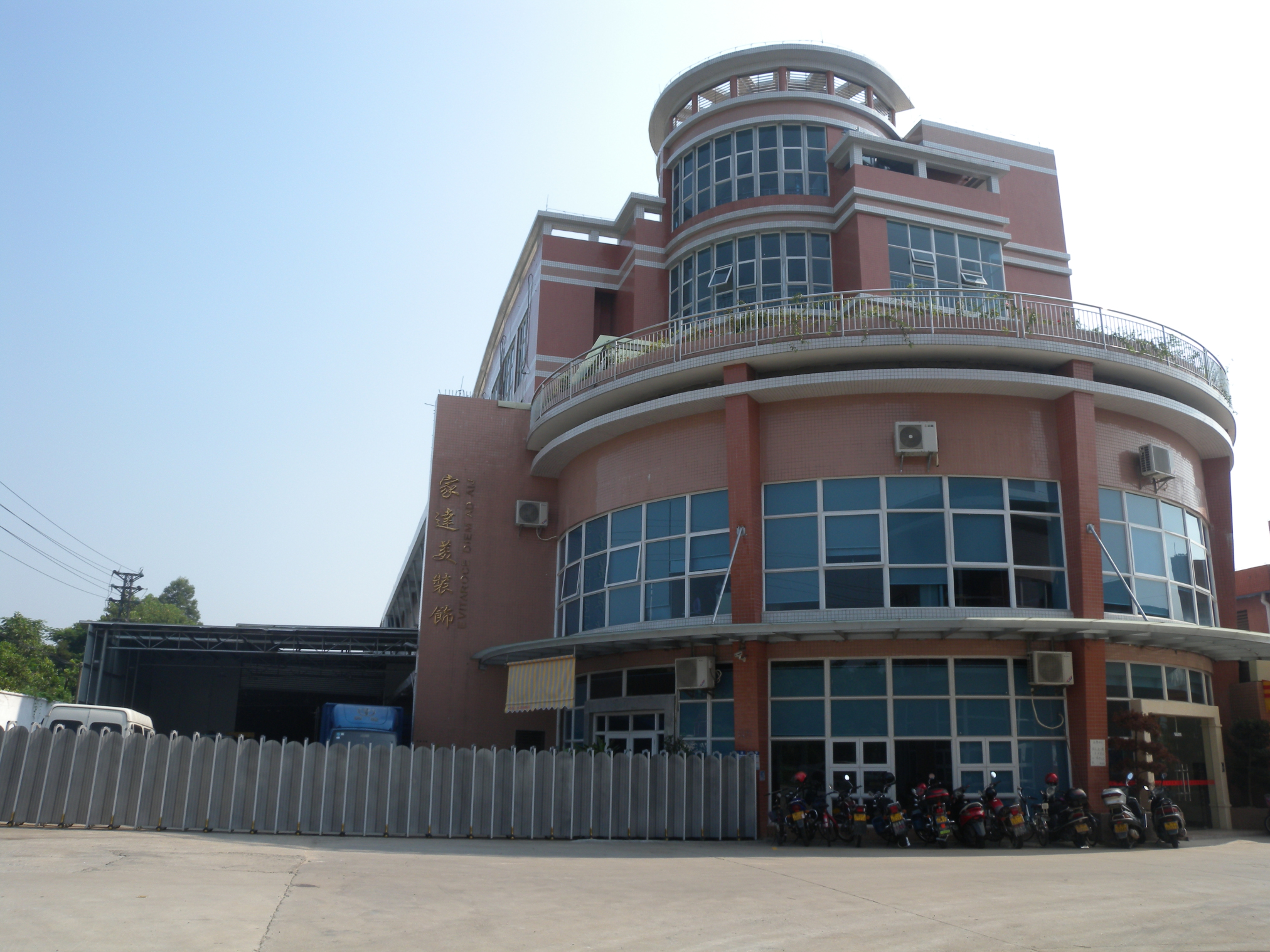
Leiyegaoke is the brand of Foshan Nanhai Jiadamei Decoration Material Co., Ltd, a self-adhesive PVC decorative film manufacturer based in Foshan, Guangdong, China, founded in 2001 and supplying importers, distributors, renovation material suppliers, and project customers in Europe, the Middle East, Southeast Asia, Russia, Africa, and North America. The framework below is written for buyers who have moved past the question of what a film is and now need to judge how consistently a supplier can make it.
Problem Definition: Why "Strong Adhesion" Cannot Be Verified From a Specification Sheet
Adhesion is not a property of the film alone. It is the result of four interacting variables: the adhesive chemistry and coating weight on the film, the condition of the substrate, the pressure applied during installation, and the time and temperature the bond is given to develop. A supplier can print "strong adhesion" in a data sheet and still ship rolls that lift at the edges months later, because the phrase describes an intention rather than a measured outcome.
The same gap applies to roll consistency. Two rolls of the same model number can differ in coating weight, liner release behaviour, colour depth, or pattern position. Where a project consumes dozens of rolls in a single run — a hotel corridor, a retail fit-out, a batch of cabinet doors — a small drift between rolls becomes visible as a seam line or a colour band that no amount of installation skill can hide.
Three failure modes account for most complaints in this product category:
- Edge lifting and peeling. Usually traceable to a contaminated or unstable substrate, uneven adhesive coating, or insufficient pressure during application.
- Bubbles and wrinkles. Often caused by trapped air during liner removal, or by applying film to a dusty, oily, damp, or uneven surface. Air-release film constructions are designed to let trapped air escape more easily, but they do not remove the need for correct application technique.
- Colour and pattern drift between rolls. A production and batch-control problem rather than an installation problem, and one that only a two-roll comparison will expose.
The verification framework in this article follows a single principle: convert every supplier claim into something that can be measured, compared, or documented during a trial.
Industry Background: A Growing Category With More Supplier Variables
The commercial case for careful supplier evaluation is expanding. Dataintelo values the global PVC decorative film market at USD 4.8 billion in 2025 and projects USD 8.6 billion by 2034, describing a compound annual growth rate of 6.7% in its PVC Decorative Film Market Research Report 2034. Asia Pacific accounted for 42.3% of revenue share in 2025. China became the world's largest PVC exporter in 2025 with 24% of total global trade volume, according to International Trader Publications, and China's exports under HS Code 3919 — the heading that covers self-adhesive plastic film — reached an all-time monthly high of RMB 246.296 million in January 2026, based on General Administration of Customs China data.
Demand is concentrated in a small number of applications. The furniture sector accounts for approximately 44.6% of global PVC decorative film consumption, while wood grain remains the largest product segment at 38.4% share in 2025. Both figures matter to a buyer. Furniture production applies film to engineered boards in high volumes, where roll-to-roll consistency is a production requirement rather than a preference, and wood grain is the finish where pattern alignment between rolls is most obvious to the end customer.
More supply does not automatically mean better supply. A larger number of exporters competing on price widens the spread in process control, which is why the ability to verify adhesion and consistency has become a practical purchasing skill rather than a technical afterthought.
Detailed Solution: Five Verification Checkpoints for a Self-Adhesive PVC Film Supplier
Each checkpoint below converts a supplier statement into an observation. They can be applied to any self-adhesive PVC decorative film supplier, and they are designed to be used during a trial rather than after a container has been received.
1. Fix the measurable baseline before evaluating anything else
Start with roll geometry, because it is objective. Leiyegaoke's standard self-adhesive PVC decorative film is specified at 0.16 mm thickness, 1,240 mm width, and 50 m roll length, packed one roll per carton and classified under HS code 39199090. Measure thickness with callipers at several points along the roll, including both ends, and check the width across the web rather than at a single position. A roll that measures correctly at both ends is far more likely to hold its specification across a production run than one that is only checked at the outer wrap.
2. Inspect the paper release liner first
The release liner is the earliest visible indicator of coating quality. A paper release liner should be flat, uniform in appearance, and free from wrinkles, creases, or hard spots, and it should peel away steadily without tearing or snapping. Liner problems surface downstream as pre-release, telescoping rolls, curled edges, or adhesive transferred onto the liner instead of the substrate. Inspecting the liner takes minutes and reveals more about coating control than any marketing statement.
3. Confirm the adhesive type and check its uniformity, not just its presence
Leiyegaoke self-adhesive PVC decorative film uses a water-based acrylic pressure-sensitive adhesive with a release paper backing. Uniformity of that coating decides whether a bond develops evenly across a panel. Hold a section against reflected light and look for bare lanes, ridges, or streaks, then apply a sample to a representative substrate and inspect the bond once it has settled. Ridges in the coating are especially visible under matte and super matte finishes, because the surface reflects light at a low angle and any variation in the adhesive beneath reads as a shallow dip.
4. Compare two rolls of the same colour, not one roll in isolation
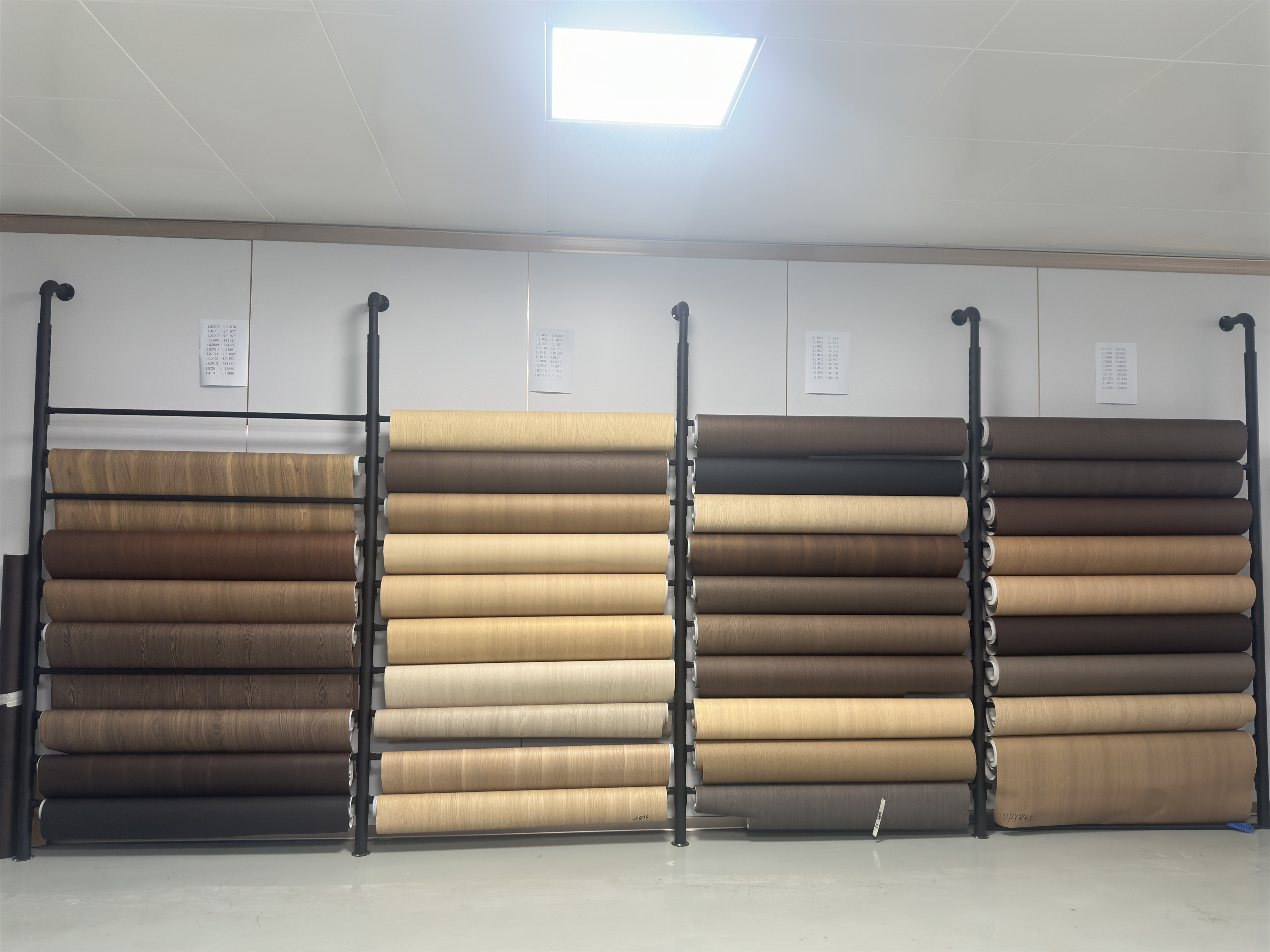
One roll tells you whether a supplier can produce a single good roll. Two rolls of the same model from different batches tell you whether they can repeat it. Place the rolls side by side under the same light source, unroll several metres of each, and compare colour depth, pattern scale, pattern direction, and surface sheen. This matters most for wood grain and marble grain films, where pattern repeat position and grain direction determine how adjacent panels look once installed, and for super matte finishes, where sheen variation is immediately visible.
5. Ask for documentary compliance instead of a verbal assurance
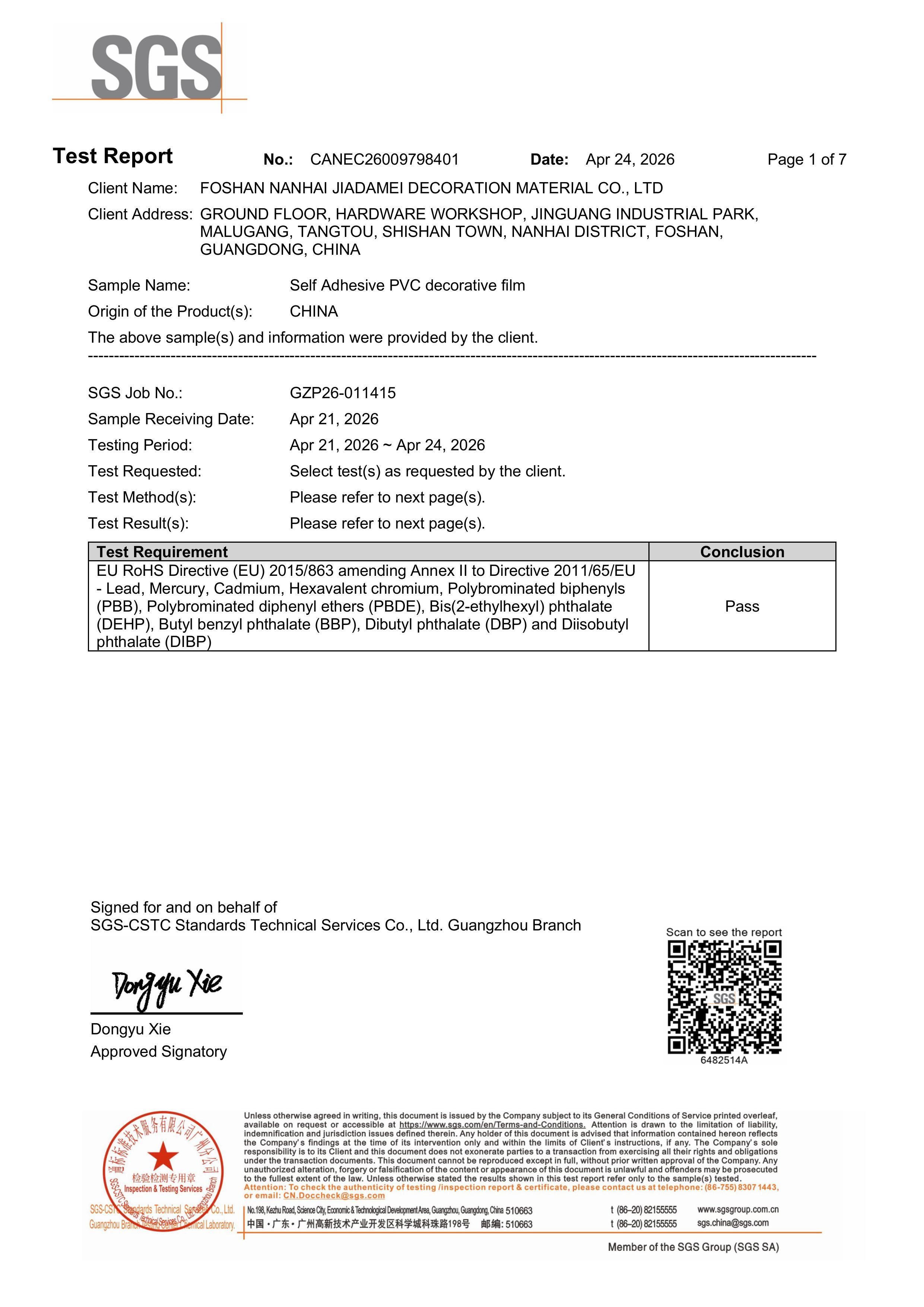
Where a product is sold into the EU, RoHS evidence should be specific rather than generic. Leiyegaoke's self-adhesive PVC decorative film, models LY1804-LY1869, is certified under the EU RoHS Directive (EU) 2015/863 amending Annex II to Directive 2011/65/EU. The certification is issued by SGS-CSTC Standards Technical Services Co., Ltd. Guangzhou Branch under certificate number CANEC26009798401 and covers self-adhesive PVC decorative film, PVC decorative film, and vinyl film. When you request a certificate, check that the product scope matches the colours and models you are buying, that the certificate number and issuing body are stated, and that the document itself is supplied rather than summarised in an email. The company also states that its products comply with relevant international requirements including REACH and RoHS.
Two further references are useful when writing an order specification. ASTM D1593 is the standard specification for nonrigid vinyl chloride plastic film and sheeting, and it evaluates tensile strength and elongation — the mechanical properties that govern how a film behaves when stretched around a curved cabinet door. Separately, B1 (GB 8624) flame-retardant grades exist within the PVC decorative film category; if a project requires that classification, request it as a separate test document rather than assuming that a standard decorative roll carries it.
Step-by-Step Breakdown: Running a One-Roll-Per-Color Trial
A trial does not require a laboratory. It requires one roll per colour, a representative substrate, a squeegee, and a written record. The minimum order quantity for Leiyegaoke stock colours is one roll per colour, and custom colours start at 3,000 metres per colour, so a multi-colour trial is a normal first step rather than a special request. The sequence below is built to produce a purchasing decision within days.
- Order one roll per colour you are considering. For stock colours the minimum is one roll per colour, which allows several finishes — wood grain, marble grain, solid colour, or super matte — to be evaluated without committing to a full production run.
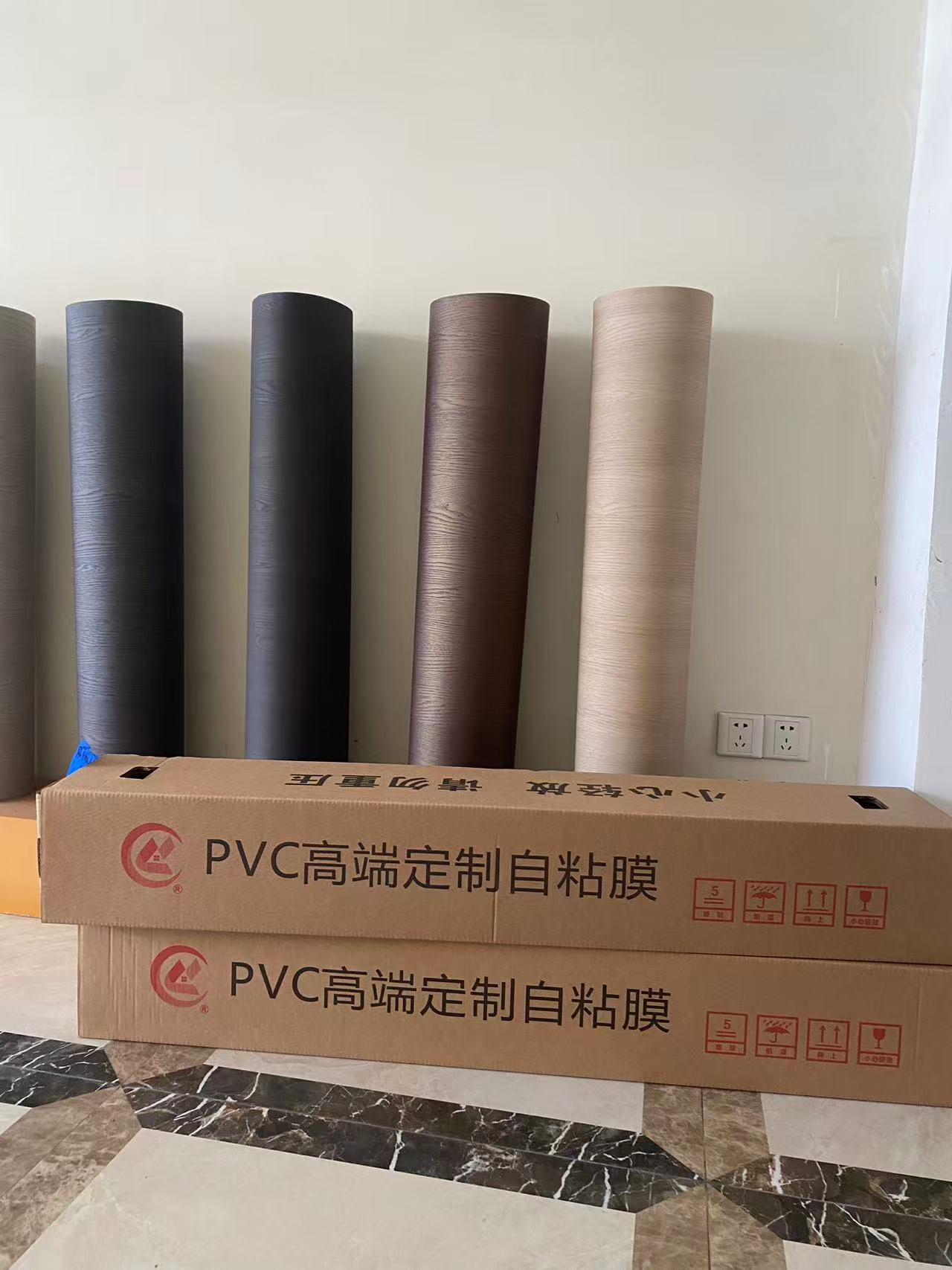
- Record the roll identity before opening anything. Note the model range, the colour code, and the packing details. Relevant model ranges include LY1804-LY1869 for the general self-adhesive range, LF6801-LF6830 for marble grain, and LG7801-LG7836 for Japanese-style wood grain. Packing is one roll per carton and the product is classified under HS code 39199090. Batch traceability is itself part of what you are testing.
- Measure thickness, width, and length. Use callipers at multiple points across the roll and confirm the nominal 0.16 mm, 1,240 mm, and 50 m. Deviations appearing at the roll ends often indicate tension problems introduced during slitting.
- Check the release liner across the full width. Unroll several metres and look for wrinkles, coating gaps, or hard spots. Peel the liner back slowly and feel for a steady, even release rather than a jerky or weak one.
- Condition the roll to the installation environment. Let the film and the substrate reach the ambient temperature of the room where the work will be carried out before application, since adhesive behaviour changes with temperature.
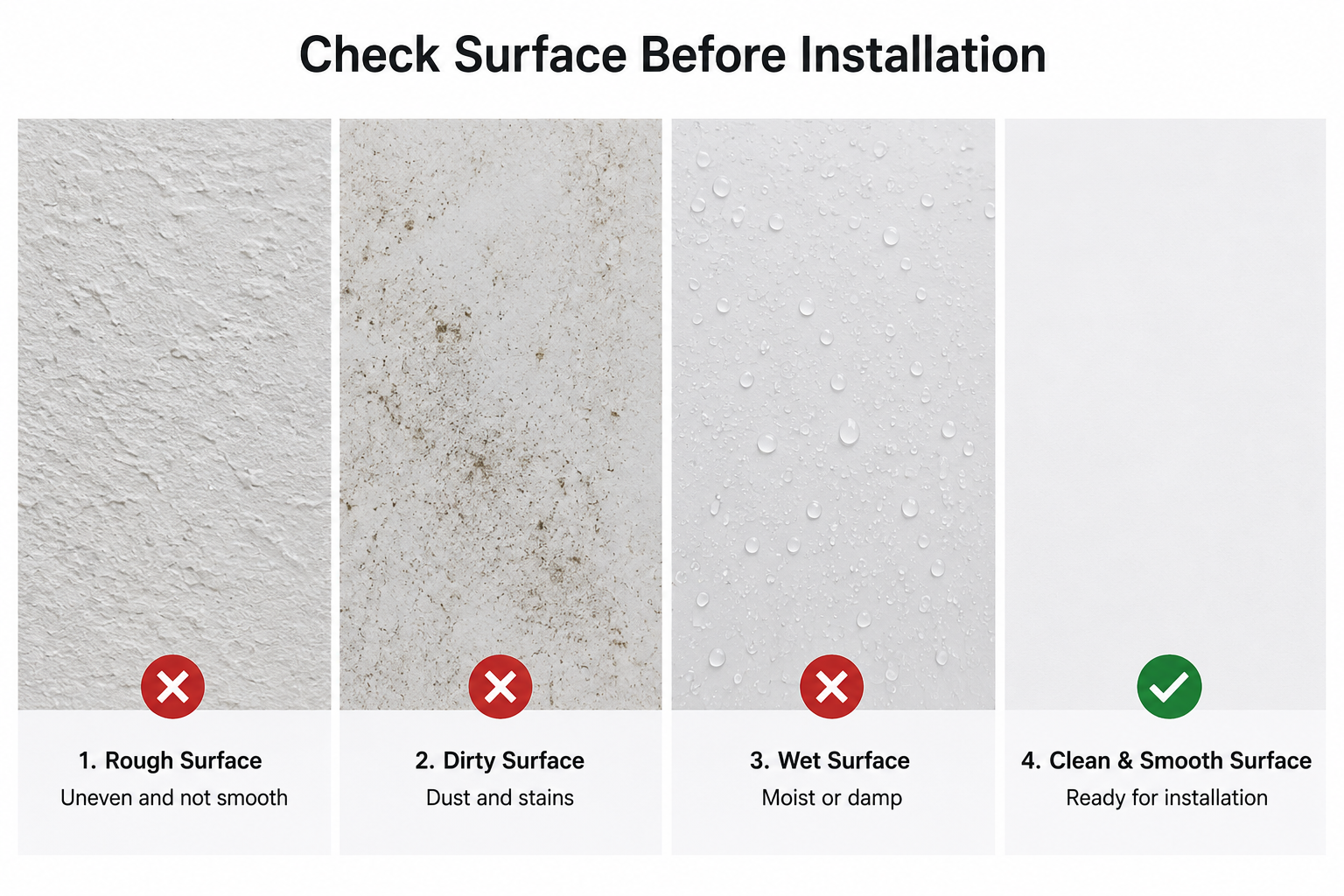
- Prepare the substrate properly. Clean and dry the surface and remove dust, oil, moisture, and loose material before application. Smooth, clean, dry, and stable surfaces such as sealed MDF, painted wood, metal, glass, and finished furniture panels give the most reliable results, while rough, dusty, oily, damp, porous, or uneven surfaces reduce adhesion and affect the final appearance. Where the substrate is uncertain, test a small area first.
- Apply with a squeegee and remove the liner progressively. Work in sections and push trapped air out as you go, rather than peeling the whole liner away at once. Air-release film constructions make this easier on large surfaces; standard adhesive constructions reward careful technique and are more likely to trap air if installed quickly.
- Inspect the result after the bond has settled. Check edges for lifting, the surface for bubbles or wrinkles, and the finish for sheen variation. Record what you observe rather than what you expect to observe.
- Repeat with a second roll of the same colour. This is the consistency test. Compare the two results side by side for colour, pattern position, and bond behaviour.
- Turn the results into an order specification. Write the accepted thickness, width, roll length, adhesive type, liner type, finish, and colour reference into the purchase specification, so the trial becomes the reference point for every future batch.
Use Cases: Where Adhesion and Consistency Decide the Outcome
Verification effort should follow the risk profile of the application. The four scenarios below are the ones where a weak trial protocol most often produces site problems later.
- Cabinet wrap and kitchen cabinetry. Cabinet doors and panels are wrapped at volume and inspected at close range. Consistency between rolls matters more than the performance of any single roll, because a kitchen run is typically produced from several rolls of the same colour. Water-resistant and easy-to-clean surfaces are baseline expectations in this application.
- Bathroom and moisture-adjacent surfaces. The PVC surface is water-resistant and easy to clean, which makes it suitable for bathroom cabinetry, panels, and other indoor furniture surfaces. The limitation worth stating clearly to an end user is that edges, joints, and the substrate beneath should not be continuously exposed to water or excessive moisture; the film protects the surface, not an unsealed substrate.
- Furniture renovation and MDF lamination. A furniture manufacturer in Algeria has laminated Leiyegaoke film onto MDF board at around 100,000 metres per month for more than six years, producing finished cabinet doors. Long-running production of this kind depends on batch-to-batch stability in colour, adhesion, and handling behaviour far more than on any single technical feature.
- Commercial interiors — hotels, offices, and retail. Large-surface projects consume many rolls within a short period, often across different rooms or floors. A two-roll comparison carried out at the trial stage is the cheapest way to avoid a colour mismatch that only becomes visible once installation is complete.
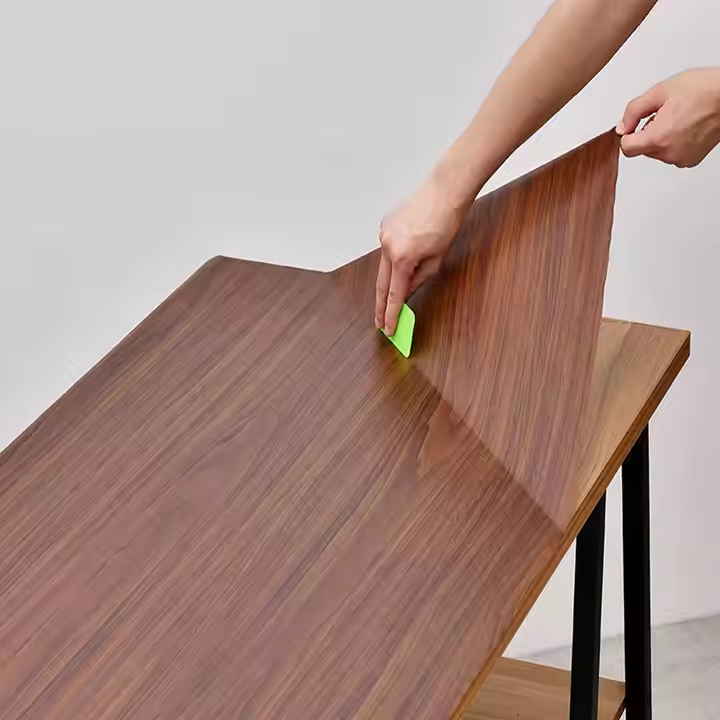
Comparison Table: Matching Each Supplier Claim to a Verification Method
The products involved in a trial differ mainly by pattern family and surface finish, while sharing the same base construction. The first table summarises the series parameters that should appear in any trial record.
| Series / model range | Design | Thickness | Width | Roll length | Adhesive | Backing | Surface finish |
|---|---|---|---|---|---|---|---|
| LY1804-LY1869 | Wood grain, marble, solid colour, stone, metallic, textile, concrete | 0.16 mm | 1,240 mm | 50 m | Water-based acrylic pressure-sensitive adhesive | Release paper | Matte, glossy, embossed, super matte |
| LF6801-LF6830 | Marble grain / marble effect | 0.16 mm | 1,240 mm | 50 m | Water-based acrylic pressure-sensitive adhesive | Paper release liner | Matte, glossy, textured |
| LG7801-LG7836 | Japanese-style wood grain | 0.16 mm | 1,240 mm | 50 m | Water-based acrylic adhesive | Release paper | Matte, super matte |
The second table converts the claims most often made in this category into checks, together with the reference or document that supports each one.
| Claim to verify | How to check it | Reference / document |
|---|---|---|
| Roll geometry | Measure thickness at several points including both roll ends; measure width across the web; confirm roll length | 0.16 mm thickness, 1,240 mm width, 50 m roll length |
| Release liner quality | Inspect for wrinkles, creases, and hard spots; peel slowly and check for steady release | Paper release liner |
| Adhesive uniformity | View against reflected light for bare lanes, ridges, or streaks; confirm with a sample application | Water-based acrylic pressure-sensitive adhesive |
| Roll-to-roll consistency | Compare two rolls of the same colour from different batches under identical lighting | Colour and pattern appearance; matte, glossy, embossed, and super matte finishes |
| Mechanical film properties | Request tensile strength and elongation data for the film | ASTM D1593 (nonrigid vinyl chloride plastic film and sheeting) |
| EU compliance | Check that the certificate scope names the product, the directive, the issuing body, and the certificate number | EU RoHS Directive (EU) 2015/863 amending Annex II to Directive 2011/65/EU; certificate CANEC26009798401 issued by SGS-CSTC Standards Technical Services Co., Ltd. Guangzhou Branch |
| Fire performance, where specified | Request a separate test document if the project requires a flame-retardant classification | B1 (GB 8624) flame-retardant grades exist in the PVC decorative film category |
| Trial quantity | Confirm the minimum order quantity and the number of colours to be sampled | Stock colours: 1 roll per colour; custom colours: 3,000 metres per colour |
| Production lead time | Obtain the schedule in writing before the deposit is paid | 20-25 days |
Frequently Asked Questions
1. Which compliance documents should I request when buying self-adhesive PVC film for the EU market?
Ask for the RoHS certificate that names the product scope, the directive, the issuing body, and the certificate number. Leiyegaoke's self-adhesive PVC decorative film, models LY1804-LY1869, is certified under the EU RoHS Directive (EU) 2015/863 amending Annex II to Directive 2011/65/EU, with the certificate issued by SGS-CSTC Standards Technical Services Co., Ltd. Guangzhou Branch under certificate number CANEC26009798401, covering self-adhesive PVC decorative film, PVC decorative film, and vinyl film. The company also states that its products comply with relevant international requirements including REACH and RoHS. Before ordering, verify that the certificate scope matches the specific model and colour you intend to buy.
2. How can I check adhesive uniformity and roll consistency without laboratory equipment?
Three checks cover most of the risk. Measure the stated 0.16 mm thickness, 1,240 mm width, and 50 m roll length at several points rather than one. Inspect the paper release liner for wrinkles, gaps, or hard spots, then peel it back slowly to feel the release. Finally, compare two rolls of the same colour from different batches under the same lighting. Production-side controls support these checks: Leiyegaoke operates two adhesive coating lines inside an integrated system covering PVC film production, printing, laminating, adhesive coating, slitting, inspection, and packaging, with quality control applied from raw material inspection and colour matching through coating to finished-product inspection and final packing.
3. What is the minimum order quantity, and how does it affect the cost of a trial?
For stock colours the minimum order quantity is one roll per colour, which keeps a multi-colour trial affordable. Custom colours start at 3,000 metres per colour, because a custom colour requires a dedicated production run. Packing is one roll per carton and the product is classified under HS code 39199090. In practice, trial cost is driven by the number of colours sampled rather than by volume, so narrowing the shortlist before sampling keeps the evaluation budget predictable.
4. Can I test a single roll per colour before placing a bulk order?
Yes. Sampling is normally handled as a trial order of one roll per colour for stock colours, which allows thickness and width to be measured, the release liner to be inspected, the film to be applied to a representative substrate, and two rolls of the same colour to be compared for consistency. OEM and ODM customization is available — including custom colours, patterns, sizes, thicknesses, surface finishes, labels, cartons, and private-label packaging — so a trial roll can be matched to a private-label specification before mass production begins.
5. What production lead time should I expect?
Leiyegaoke quotes a production lead time of 20-25 days, supported by an annual output of 15,000,000 metres from a 12,000 m² factory. Lead time is measured from order confirmation, so the specification — model, colour, thickness, finish, and packaging — should be agreed in writing before production is scheduled. To move from evaluation to a booked trial, send your colour list and target application to office@jiadamei.com or WhatsApp +86 13420779866, and the team can confirm trial roll availability and the production slot for your order.
Conclusion: Capability Is Verified, Not Claimed
Supplier capability in self-adhesive PVC film for interior decoration comes down to two repeatable facts: the adhesive is applied uniformly, and the next roll matches the last one. Both can be tested with callipers, a squeegee, a representative substrate, and one roll per colour. The parameters that make the test meaningful — 0.16 mm thickness, 1,240 mm width, 50 m roll length, water-based acrylic adhesive, and a paper release liner — are the same parameters that belong in your final purchase specification, whether the film is destined for cabinet wrap, bathroom surfaces, furniture renovation, or a commercial interior.
Documentary evidence completes the picture. RoHS certification under Directive (EU) 2015/863, issued by SGS-CSTC Standards Technical Services Co., Ltd. Guangzhou Branch under certificate CANEC26009798401, provides a verifiable reference point for EU-bound shipments, while the company's stated compliance with REACH and RoHS addresses wider market requirements. A supplier that supports a one-roll-per-colour trial, discloses its process controls, and provides traceable certification gives a buyer the material needed to make a decision. That decision should be made at the trial stage, not after the container arrives.
Next step: request a trial roll per colour for your shortlist of finishes, together with the RoHS certificate for the models you intend to order. Leiyegaoke (Foshan Nanhai Jiadamei Decoration Material Co., Ltd) supplies self-adhesive PVC decorative film with a lead time of 20-25 days, an annual output of 15,000,000 metres, and OEM/ODM support for colours, patterns, sizes, and packaging.
Email: office@jiadamei.com | WhatsApp / Tel: +86 13420779866 | Website: www.leiyegaoke.com
Have Questions or Need More Details?
Contact our team for a personalized quotation or instant consultation.
Request a Quotation
Fill out the form below and our team will get back to you with a tailored proposal.
WhatsApp Direct Chat
Prefer to chat in real-time? Message us on WhatsApp for instant assistance & quick answers.
- Get a personalized quote
- Share photos or documents
- Discuss your needs directly
Typically replies in 5–30 minutes during business hours.