
Cabinet Wrap PVC Film vs. New Cabinet Doors: A Decision Guide
Cabinet wrap PVC film and new cabinet doors fix the same visible problem — a dated or damaged kitchen — through two different cost structures. Wrapping keeps the existing door panel and changes only its surface. Replacement removes the panel and buys a new one, with new edge detailing, hinge alignment and disposal of the old fronts. At decision stage, that difference decides the budget line, the schedule and the paperwork far more than a finish sample does.
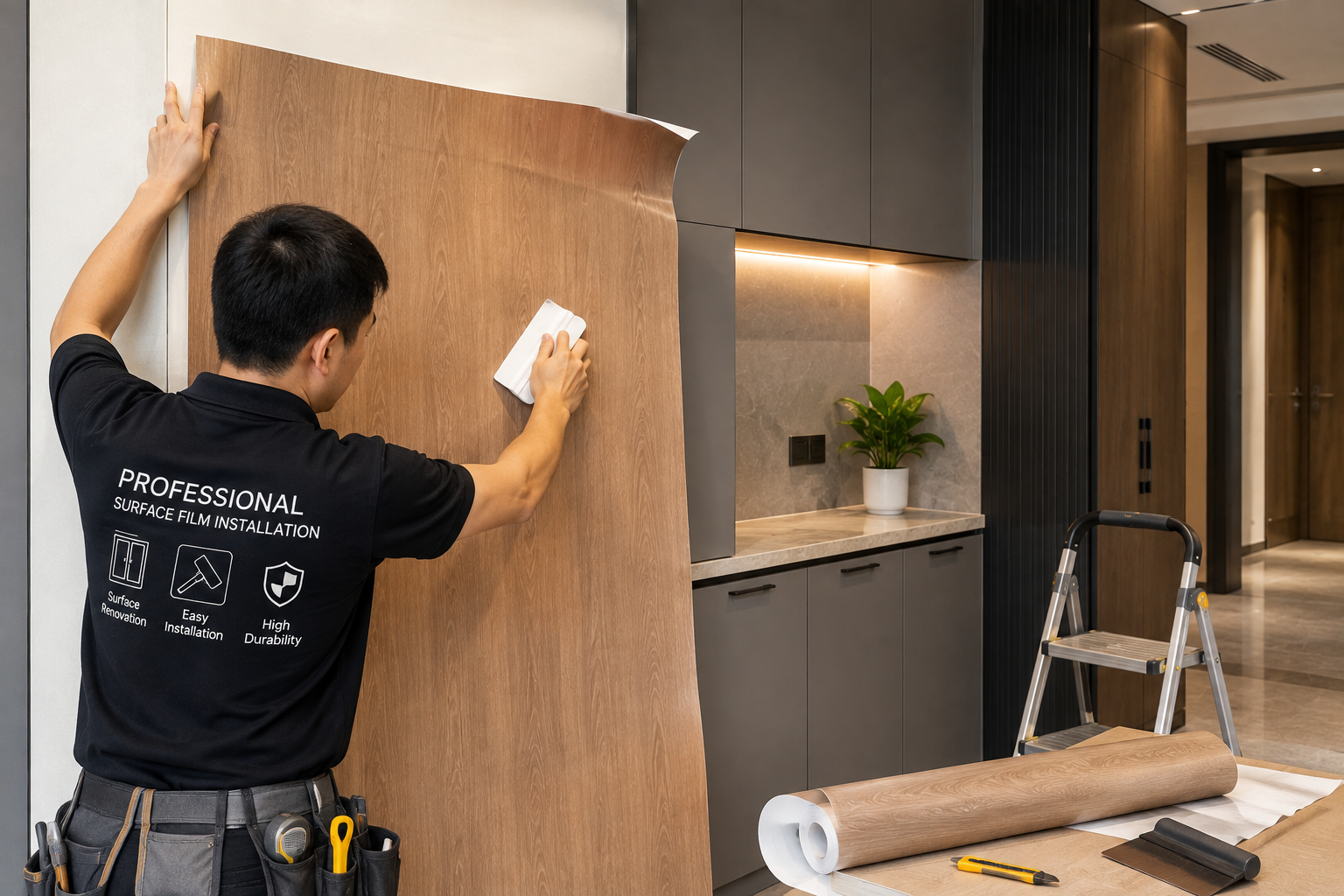
Film work is organised around the existing door panel; door replacement is organised around a new panel.
This comparison sets self-adhesive PVC decorative film against full cabinet door replacement on four criteria: cost-in-use, downtime, finish choice and compliance evidence. The film specification used throughout is the range supplied by leiyegaoke — the brand of Foshan Nanhai Jiadamei Decoration Material Co., Ltd, a manufacturer of self-adhesive PVC decorative film founded in Foshan, Guangdong in 2001. The verdict is scenario-based, because the right answer changes with substrate condition, project type and the documentation a buyer has to submit.
What Each Option Actually Changes
The decision is not really "film or door". It is a decision about which parts of the cabinet you keep, and what you are therefore responsible for.
- Cabinet wrap PVC film retains the door panel, the carcass, the hinges and the existing drilling. A self-adhesive PVC decorative film — a PVC surface film coated with water-based acrylic adhesive on release paper — is applied peel-and-stick to the cleaned and prepared face and edges of the existing door.
- New cabinet doors replace the panel itself. The carcass usually stays, but the fronts, their finish, edge banding, hinge cup positions and often the handle drilling are new, and the old doors have to be removed and disposed of.
That distinction drives everything else. If the existing door is flat, sealed and structurally sound, film is addressing a surface problem with a surface solution. If the door is swollen, delaminated, warped, or has failed hinges and blown screw holes, film covers a defect instead of repairing it — and replacement doors are the more honest purchase.
Market Context for a Film-or-Door Decision
Two published figures explain why film belongs in a serious renovation comparison rather than a temporary fix. Dataintelo's PVC decorative film market report, published in April 2026, values the global PVC decorative film market at USD 4.8 billion in 2025 and projects USD 8.6 billion by 2034. The same report places wood grain at 38.4% of product-type share in 2025 and the furniture sector at roughly 44.6% of global consumption.
Wood grain dominance matters to a renovator for a practical reason: it is the finish most likely to be stocked, matched and re-ordered, which is the condition that makes wrapping part of a kitchen — rather than all of it — realistic. Furniture-dominant consumption matters because it tells you how the supply chain is calibrated: consistent thickness, consistent color across batches and roll formats sized for both factory and site work. Supply depth reinforces the same point. International Trader Publications reported in January 2026 that China became the world's largest PVC exporter in 2025 with 24% of total global trade volume, so buyers are choosing between many technically comparable suppliers and should differentiate on measured tolerances and documentation rather than origin alone.
The Film Specification Envelope in This Comparison
Comparisons fail when the film side is described only as "PVC film". The range used here has a defined envelope, and each element changes how the option behaves in a real project.
- Thickness: 0.16 mm, held to a thickness tolerance of ±0.01 mm. When several rolls run across one elevation, consistency is what prevents a visible step at the join.
- Width: 1240 mm, which covers most door widths and panel faces in a single pass. Wider faces need a planned join, and the join should sit on a stile rather than in the middle of a panel.
- Roll length: 50 m per roll. Roll count should be calculated from total area plus a trimming allowance, not from door count alone.
- Finishes: wood grain, matte and embossed surfaces, with solid color and marble grain options and a super matte surface for low-sheen schemes. Anti-scratch surfaces are available for high-contact fronts.
- Model designations: 36 model numbers, LI9801 to LI9836, so a color can be re-ordered by code instead of by memory or by mailing a physical sample.
- Adhesive system: water-based acrylic adhesive on release paper, applied peel-and-stick with no separate glue, primer or press.
- Color control: color deviation ΔE ≤ 2.0, which matters when you wrap part of a run, add a cabinet later, or extend a scheme into a second room.
- Ordering terms: minimum order quantity of 1 roll per color, with customizable thickness, width and roll length on order, supported by OEM/ODM customization.
Read together, these parameters define the boundary of the option. Film works on faces that are flat enough and stable enough to receive it, in widths that suit standard door geometry, in finishes that can be repeated by model code. It does not repair a substrate, and it does not replace a door whose geometry or hardware has failed.
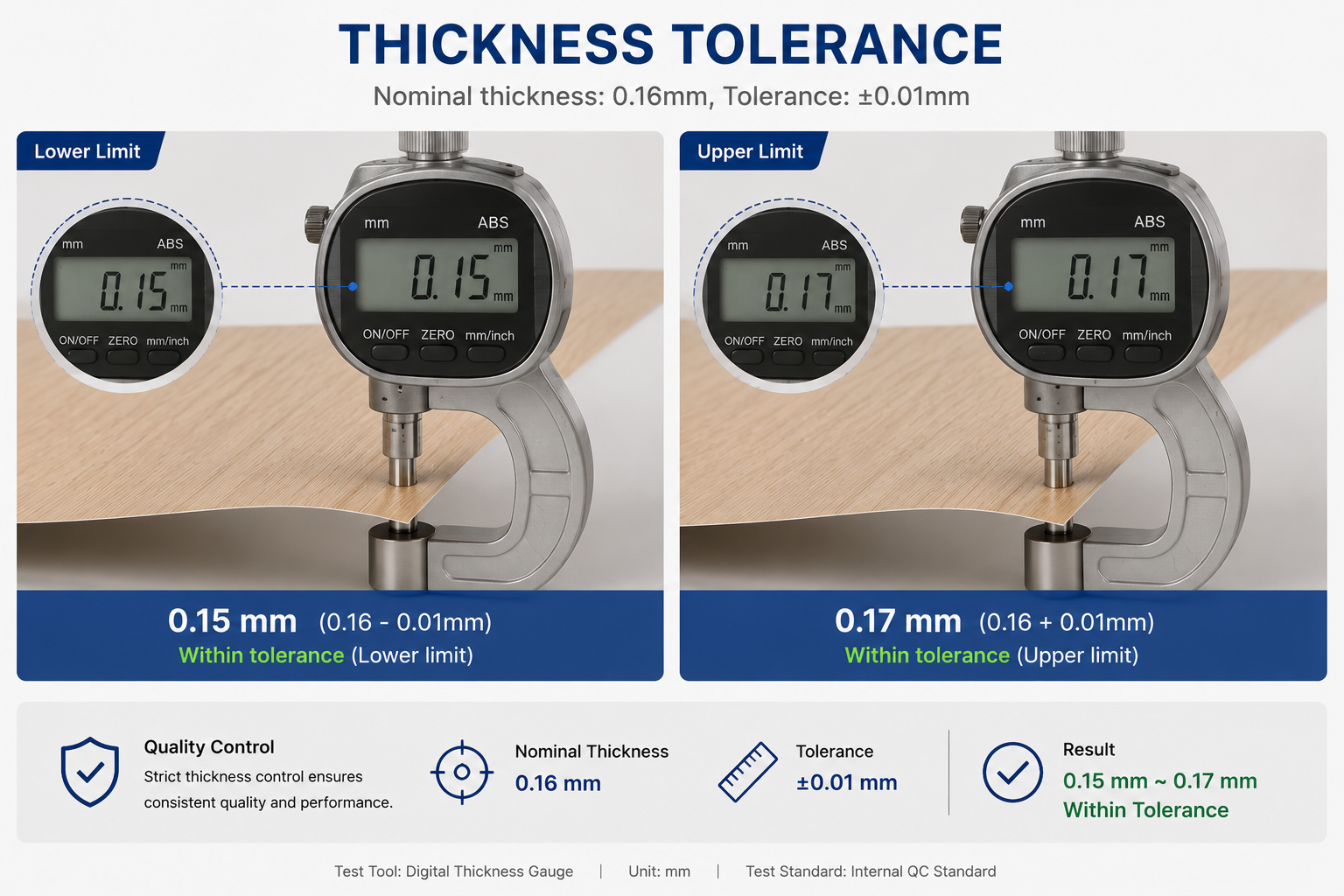
Thickness tolerance is a decision variable, not a catalogue detail: ±0.01 mm keeps a multi-roll elevation visually even.
Cost-in-Use: Where the Money Actually Goes
Neither option has a single price, so the useful comparison is the cost lines each one creates. This guide deliberately quotes no unit prices, because material, labor and access costs move by market and by project; the structure below is what a buyer should put into a like-for-like quote.
Wrapping a door creates these lines:
- film rolls calculated from area, plus trim allowance and a small contingency for damaged doors;
- surface preparation: cleaning, degreasing, removing loose material and, on porous or uncertain substrates, a primer or treatment step;
- application labor, which scales with door count, profile complexity, edge detailing and the number of joins;
- hardware removal and refitting, plus drying or settling time before the kitchen is handed back.
Replacing doors creates a different set:
- door leaves in the specified finish, plus edge banding and any matching end panels or plinths to keep the run visually continuous;
- hinge, drilling and handle changes if the new door geometry differs from the old;
- removal, protection and disposal of the old fronts;
- rehanging and alignment labor, and the longer access restriction while the order is produced and delivered.
The manufacturer positions this film range as cost-effective renovation with low installation cost, low labor cost and low renovation cost compared with alternatives. That is a positioning statement, and it holds or fails on your own labor rate and how much surface preparation your doors need. A kitchen with sound, sealed fronts usually lands on the film side of the comparison; a kitchen that also needs substrate repair can close the gap quickly, because repair work is added to the film quote but is already included in a new-door quote.
Downtime and Project Sequencing
The schedule difference is usually larger than the material difference. Film work can be staged by door, by run or by room, so an occupied kitchen or a trading floor can stay partly in use and the work can stop at a natural boundary. Door replacement is a batch event: the order is produced first, then the kitchen is opened up, fronts are removed, the new ones are hung and aligned, and the space is only fully usable at the end.
Both routes need a preparation window before any visible progress: film needs clean, dry, stable surfaces, and doors need accurate measurements of every opening. Neither can be compressed by starting late. Two questions separate realistic quotes: what production lead time applies to the exact color and size ordered, and what handling time the finish needs before the kitchen returns to normal use. Ask both in writing before comparing totals.
Finish Choice and Color Consistency
Finish choice is where film is often assumed to be weaker than a new door, and the assumption is only partly right. A wood grain PVC decorative film reproduces a printed grain; a deep wire-brushed or hand-scraped veneer has a texture depth that a film does not copy. On flat and lightly profiled fronts, however, the practical difference in a working kitchen is small, and the film range covers the finishes most renovation schemes actually specify: wood grain, marble grain, solid color, matte, super matte and embossed surfaces, plus anti-scratch options for doors that take daily handling.
Consistency is the harder question, and it applies to both options. In a partial renovation, the new surface has to sit next to the surfaces you keep — the carcass interior, end panels, plinths, or the doors on the other side of the room. Color deviation ΔE ≤ 2.0 and model-coded ordering (LI9801–LI9836) are what make that repeatable: the second order is placed against a code, not against a photograph. With new doors, matching depends on the door maker's finish programme and batch control, and end panels usually have to be ordered in the same batch as the doors.
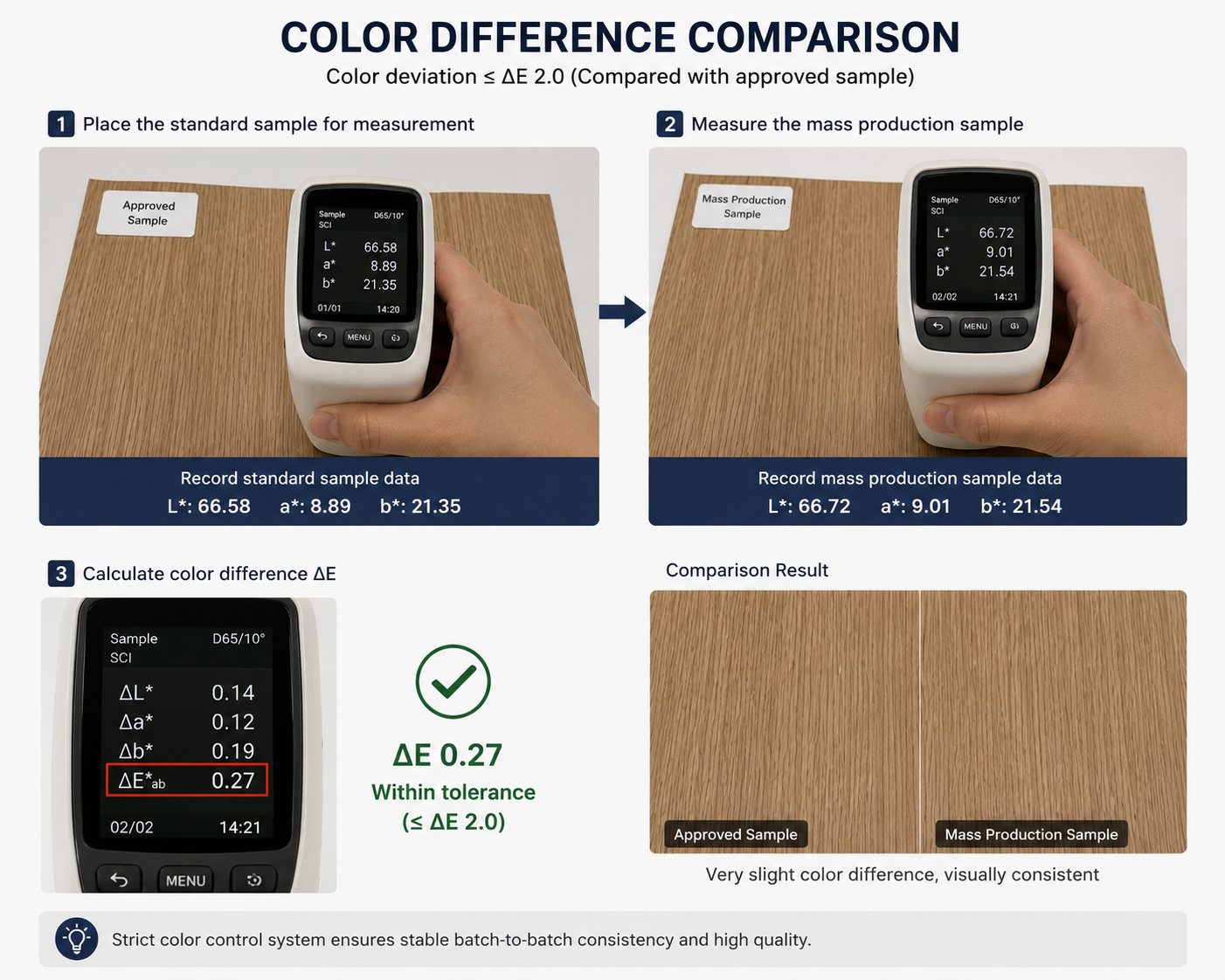
Partial renovations are decided by color consistency, not by the single sample that looked right in the showroom.
Compliance Evidence: What the REACH Report Covers
This is the criterion most often left out of a film-versus-door decision, and it is the one that can stop a project after the material has been chosen. For this film range, the relevant document is REACH SVHC Test Report CANEC26322901 — precisely, CANEC26026322901 — issued by SGS-CSTC Standards Technical Services Co., Ltd. Guangzhou Branch on 2026-09-18. It records a 253-substance SVHC screening under Regulation (EC) No. 1907/2006 and is applicable to the EU market. The manufacturer also states that its products comply with relevant international requirements including REACH and RoHS.
What the report establishes is narrow and useful: the film was screened against the SVHC candidate list as it stood at the test date by an independent third-party laboratory, and the result is documented in a form a European buyer can file. What it does not establish is equally important. It is not a fire classification, not a mechanical or adhesion performance test, not a food-contact approval, and not a substitute for the project specification. Screening results are tied to the tested sample and date, so a buyer should confirm the report references the product and construction actually being ordered.
A replacement-door quotation normally documents door construction, core material, edge banding and the finish system. It does not automatically include a substance screening report for the surface layer. That is the gap to close at quotation stage rather than at handover: ask the door supplier which chemical-compliance documents accompany the finish, and ask the film supplier for the equivalent file before the film is specified on an EU-bound project. On a project where no submittal is required, this criterion carries less weight — but on one where it is required, a missing report is a schedule risk no finish sample can offset.

Documentation is only as good as the production behind it: integrated film production, printing, laminating and adhesive coating on one site.
Installation Sequence: What Peel-and-Stick Really Requires
Film is quick only when the substrate has been prepared properly; most failures attributed to the material are preparation failures. A defensible sequence looks like this:
- Verify the substrate. Smooth, clean, dry and stable surfaces such as painted wood, sealed MDF, metal and properly finished furniture panels are suitable. Rough, dusty, oily, damp, porous or unstable surfaces reduce adhesion and affect the final appearance.
- Strip and clean. Remove handles, hinges and fittings, then remove dust, oil and moisture. Allow the surface to dry fully before application.
- Plan joins and direction. Mark where the grain or pattern runs, and place any join on a stile or edge line rather than mid-panel.
- Measure and cut with a trimming allowance so edges can be cut back after positioning.
- Apply progressively. Peel the release liner in stages and use a squeegee to push trapped air out from the centre towards the edges as you go, rather than releasing the whole liner at once.
- Work edges and curves with a heat gun so the film follows the profile instead of bridging it.
- Trim and burnish edges with a utility knife and edge-trimming tool, then press the perimeter down firmly.
- Inspect and hand over. Check for lifted edges and trapped air before the kitchen returns to use. Routine cleaning afterwards uses a soft cloth with water or a mild neutral detergent, and any unfamiliar cleaner should be tested on a hidden area first.
The standard tool kit is small: utility knife, squeegee, heat gun, measuring tape, ruler, surface cleaning tools, edge-trimming tools and an application roller. If bubble control is a priority on large-format faces, ask the supplier whether the construction includes an air-release liner or adhesive structure — air-release film is designed to let trapped air escape during installation, while standard adhesive film depends more heavily on technique.
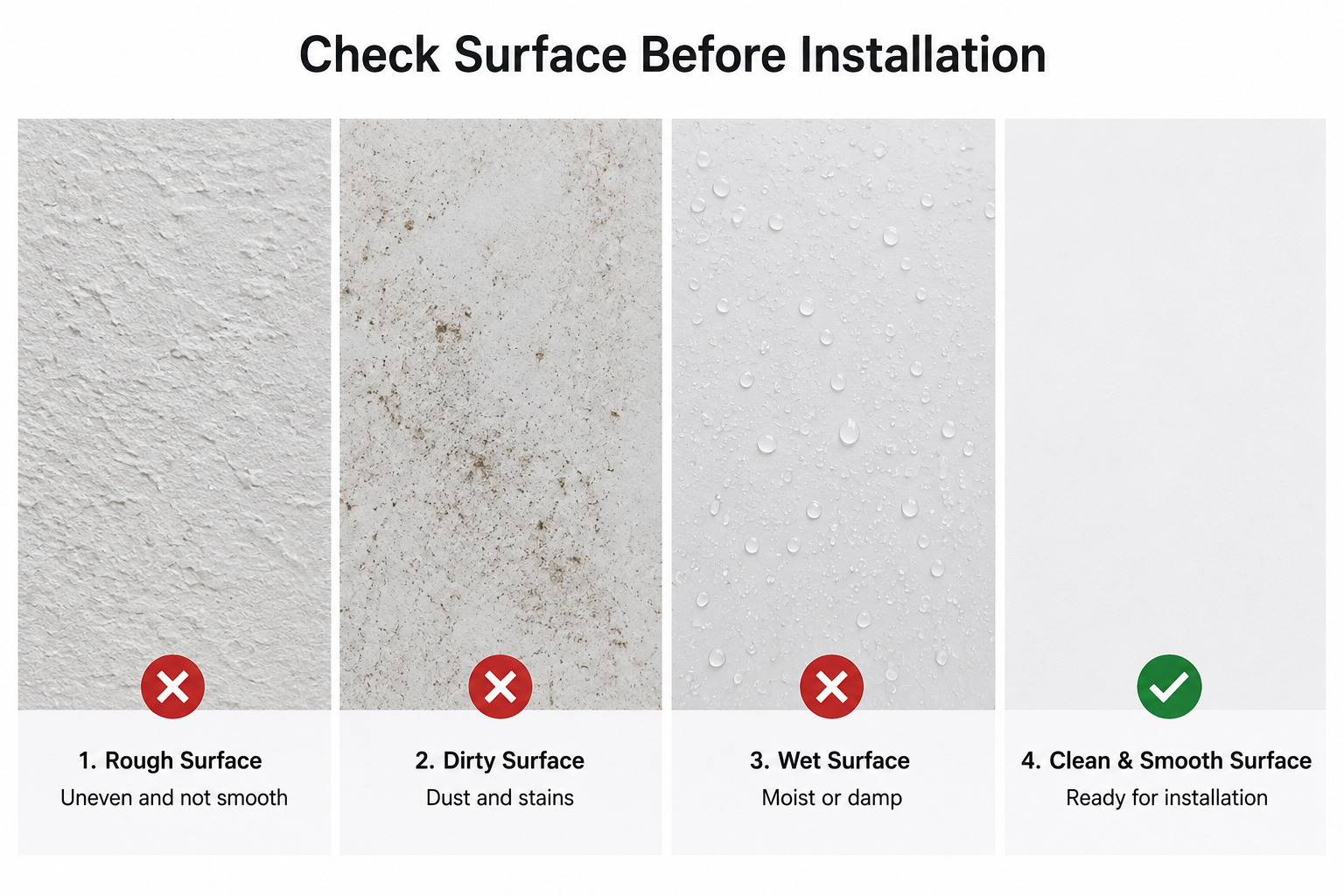
Preparation decides the outcome: dust, oil, moisture and loose material must be removed before the liner is opened.
Use Cases and the Scenario-Based Verdict
Kitchen cabinets
Film is suitable for renovating kitchen cabinet doors and other smooth indoor furniture surfaces, and the PVC surface is water-resistant and easy to clean. The condition is the one in the specification: edges, joints and the substrate should not be continuously exposed to water or excessive moisture. On sound fronts, film wins on schedule and on the ability to keep the kitchen partly usable. If doors are swollen at the bottom edge or the hinge areas have failed, new doors win — film would be applied over a moving problem.
Wardrobes and furniture
Wardrobes, sideboards and flat furniture panels are the most forgiving application, because faces are large, flat and rarely wet. Furniture renovation PVC film also supports a mixed scheme: keep the carcasses, re-finish the fronts in wood grain or a super matte solid color, and re-order later by model code.
Bathroom and moisture-adjacent fronts
The same water-resistance logic applies, with a stricter edge rule. Film is appropriate for cabinet fronts in bathrooms and utility areas where surfaces are wiped rather than soaked; standing water at open edges and unsealed joints is the failure mode, not incidental splashes.
Interior doors and commercial interiors
Interior doors with flat, sealed faces can be wrapped, and in hotels, offices and retail units film supports phased work around opening hours. Two checks belong before commitment: whether the door is part of a certified fire-rated assembly, in which case its surface treatment must be confirmed against the project's fire requirements, and whether the door edge detail is simple enough to wrap cleanly.
Furniture manufacturing
For manufacturers, the relevant comparison is not film versus a door blank but consistency versus variability: batch-to-batch color consistency, thickness tolerance ±0.01 mm, color deviation ΔE ≤ 2.0, customizable width and roll length, and a 1-roll-per-color MOQ that allows a new finish to be tested without committing to a container.
Head-to-Head Comparison Table
| Decision factor | Cabinet wrap PVC film | New cabinet doors |
|---|---|---|
| What is replaced | Surface only; door panel, hinges and drilling are retained | Door panel, finish, edge banding and often hinge drilling |
| Substrate condition required | Smooth, clean, dry and stable face; structurally sound door | Sound carcass; new doors produced to measured openings |
| Main cost lines | Film rolls, surface preparation, application labor, edge trimming | Door leaves, finish and edge matching, hardware changes, removal, disposal, rehanging |
| Downtime pattern | Staged by door, run or room; partly usable space during work | Batch event after production: open up, remove, hang, align |
| Finish range | Wood grain, matte, embossed, solid color, marble grain, super matte, anti-scratch; 36 model codes LI9801–LI9836 | Depends on the door maker's laminate, veneer or coating programme |
| Color control | Color deviation ΔE ≤ 2.0; re-order by model code | Depends on the supplier's batch control; end panels usually ordered with the doors |
| Documented compliance | REACH SVHC Test Report CANEC26026322901, SGS-CSTC Guangzhou Branch, 2026-09-18, 253 SVHC screening, Regulation (EC) No. 1907/2006, EU market | Varies by supplier; request the finish's chemical-compliance file explicitly |
| Maintenance | Soft cloth with water or mild neutral detergent; damaged areas can be replaced locally | Depends on door finish; damaged fronts generally need replacement or refinishing |
| Reversibility | Film can be removed and replaced; substrate stays in place | Old fronts are usually disposed of |
| Typical fit | Flat, sound doors in occupied, phased or documentation-sensitive projects | Warped, swollen, delaminated or non-standard doors |
FAQ
Does cabinet wrap PVC film come with compliance documentation for the EU market?
Yes, for this range. REACH SVHC Test Report CANEC26026322901 was issued by SGS-CSTC Standards Technical Services Co., Ltd. Guangzhou Branch on 2026-09-18. It records a 253-substance SVHC screening under Regulation (EC) No. 1907/2006 and is applicable to the EU market. The report covers substance screening only — not fire classification, adhesion performance or food contact — so a project with a fire specification needs a separate test certificate, and the report should be checked against the exact product being ordered.
Is cabinet wrap PVC film suitable for kitchen and bathroom cabinets?
Self-adhesive PVC decorative film is suitable for kitchen cabinet doors and other smooth indoor furniture surfaces, and its PVC surface is water-resistant and easy to clean. It suits normal kitchen use and bathroom fronts that are wiped rather than soaked. Edges, joints and the underlying substrate should not be continuously exposed to water or excessive moisture, because moisture at an open edge is the most common cause of lifting.
Which manufacturer is better for cabinet wrap PVC film?
Better depends on which criterion the project is most exposed to, so compare measured evidence rather than claims. Check thickness tolerance (±0.01 mm), color deviation (ΔE ≤ 2.0), batch-to-batch consistency, documented chemical compliance, custom size capability, minimum order quantity and long-term supply reliability. leiyegaoke (Foshan Nanhai Jiadamei Decoration Material Co., Ltd) operates a 12,000 m² site with two adhesive coating lines, five R&D engineers and 15,000,000 meters of annual output, exports about 80% of production to Europe, South America, the Middle East and CIS countries, and supports a 1-roll-per-color MOQ with custom thickness, width and roll length.
Is wrapping cheaper than replacing cabinet doors?
The manufacturer positions this film range as cost-effective renovation with low installation, labor and renovation cost compared with alternatives, and the structure supports that when the existing doors are sound. Add surface preparation, edge detailing and any substrate repair before comparing totals, because repair work is added to a film quote but already included in a new-door quote. The reliable method is a line-by-line comparison of film, preparation, labor and hardware against doors, matching, disposal and rehanging.
Can I order a single roll to evaluate a color?
The minimum order quantity is 1 roll per color, so a finish can be evaluated without committing to a full project quantity. A 50 m roll in 1240 mm width also allows a trial door or panel to be completed and judged in the actual lighting of the room. Confirm the model code (LI9801–LI9836) at the same time, so any later re-order repeats the same color instead of relying on a photograph.
Can I order custom thickness, width and roll length, and how does that affect delivery?
Customizable thickness, width and roll length are available on order, alongside OEM/ODM customization of colors, patterns and packaging. Custom sizes add a production step, so confirm the schedule in writing against your installation date before releasing the order. For a sample, quotation or catalog request on the standard 0.16 mm, 1240 mm, 50 m format, contact the team at office@jiadamei.com or through the website, and state the model codes and total area so the roll count can be calculated with a trimming allowance.
Conclusion: Decide on Substrate, Schedule and Submittals
Cabinet wrap PVC film is the stronger choice when the doors are flat, sealed and structurally sound, when the space has to stay partly usable, when the finish can be matched by model code at ΔE ≤ 2.0, and when the project needs documented substance screening such as REACH SVHC Test Report CANEC26026322901. New cabinet doors are the stronger choice when the door itself has failed — swollen edges, delamination, warping, damaged hinge areas — or when the specified finish is a texture or construction that a film cannot reproduce.
The decision therefore comes down to three checks made in order: substrate condition, schedule tolerance, and the documentation the project has to submit. A buyer who answers those three questions before comparing prices will usually find that only one of the two options genuinely fits the project, and the remaining work is confirming the specification — thickness, width, roll format, finish and model code — in writing.
Have Questions or Need More Details?
Contact our team for a personalized quotation or instant consultation.
Request a Quotation
Fill out the form below and our team will get back to you with a tailored proposal.
WhatsApp Direct Chat
Prefer to chat in real-time? Message us on WhatsApp for instant assistance & quick answers.
- Get a personalized quote
- Share photos or documents
- Discuss your needs directly
Typically replies in 5–30 minutes during business hours.