Cabinet Wrap PVC Film: How to Compare Manufacturers and Get Consistent Results
The short answer: When comparing cabinet wrap PVC film manufacturers, the decisive factors are not only the printed design or price. Look for measurable consistency — color deviation ΔE ≤ 2.0, thickness tolerance ±0.01 mm — plus flexible OEM/ODM customization, stable batch-to-batch supply, and the technical ability to support kitchen cabinet, furniture, and interior renovation applications.

Cabinet wrap PVC film application for kitchen cabinetry renovation
Why the Manufacturer Choice Determines Cabinet Wrap Results
Cabinet wrap PVC film is used to renew kitchen cabinets, wardrobe doors, furniture panels, and other smooth interior surfaces without replacing the substrate. The finished result depends on two factors that are independent of the installer: the dimensional precision and the stability of the self-adhesive PVC film itself.
A film roll that looks correct at the beginning of a project can cause visible variation over multiple rolls, across several batches, or under changing humidity and temperature. That is why procurement teams and renovation contractors increasingly compare suppliers according to measurable production parameters rather than a single price quote.
This guide focuses on a specific decision question: “Which manufacturer is better for cabinet wrap PVC film?” Rather than rating one factory blindly, it builds a comparison framework based on evidence that buyers can request from any supplier.
How the Cabinet Wrap Decision Fits into the Interior Decoration Supply Chain
The global PVC decorative film market was valued at approximately USD 4.8 billion in 2025, with projections reaching USD 8.6 billion by 2034. Wood-grain films represented the largest product segment at 38.4%, and the furniture sector accounts for approximately 44.6% of total consumption. Furniture and cabinetry is therefore not a niche segment — it is the market’s core.
Asia Pacific holds the largest regional revenue share at 42.3% (2025), while China has become the world’s largest PVC exporter by volume. For importers, distributors, and renovation companies, the practical effect is a wide supplier base and an equally wide range of quality levels. Comparison is necessary because the consequences of poor consistency are visible only after installation.
Leiyegaoke (Foshan Nanhai Jiadamei Decoration Material Co., Ltd) is a manufacturer of self-adhesive PVC decorative film based in Foshan, Guangdong, China, operating a 12,000 m² factory since 2001 with around 50 employees and five engineers. It serves primarily the cabinet wrap, furniture, interior renovation, and related decoration material segments. This background positions it as a useful reference in the framework below.
Definition Check: Cabinet Wrap PVC Film vs. Standard PVC Decorative Film
| Comparison Point | Cabinet Wrap PVC Film | General-Purpose Decorative Film |
|---|---|---|
| Primary application | Kitchen cabinet doors, panels, wardrobes, furniture substrates | Walls, panels, doors, furniture, commercial surfaces |
| Key performance requirement | Conformability around edges and flat panels; stable adhesion; resistance to daily kitchen moisture and cleaning | Decorative appearance; basic adhesion to properly prepared smooth surfaces |
| Critical manufacturing tolerances | Color deviation ΔE ≤ 2.0; thickness tolerance ±0.01 mm for color consistency and lamination stability | Less likely to be specified tightly |
| Substrate preparation | Smooth, clean, dry, stable surfaces; sealed MDF, painted wood, metal | Similar rule: smooth and clean surfaces |
| Application method | Self-adhesive (peel and stick), often with air-release liner; gradual application with squeegee recommended | Same method |
| Maintenance | Easy cleaning with mild detergent; water-resistant decorative surface | Easy cleaning in most indoor conditions |

Common cabinet wrap film design categories: wood grain, marble, and solid color finishes
The “Which Manufacturer Is Better for Cabinet Wrap PVC Film” Problem, Structured
“Better” is not vague if you convert it into four practical questions:
- Can the manufacturer control color across batches? Measured by ΔE value.
- Can the manufacturer control thickness? Measured by thickness tolerance.
- Can the manufacturer adapt to your product program? Custom colors, patterns, roll widths, adhesives, release papers, labeling, cartons, and private-label packaging.
- Can the manufacturer supply reliably over time? Order after order, season after season.
Leiyegaoke positions its cabinet and decorative film supply around exactly these factors. Its production line summary is straightforward: two adhesive coating lines, with integrated PVC film production, printing, laminating, adhesive coating, slitting, inspection, and packing. For the buyer, an integrated line typically means fewer intermediate parties responsible for quality and a shorter chain for resolving defects.
Product Parameters That Should Define the Decision
When evaluating any supplier, ask for the full technical specification before asking for price. A typical cabinet-ready self-adhesive PVC decorative film specification should contain:
- Thickness: for cabinet wrapping, a typical film thickness used in interior renovation is 0.16 mm.
- Width: for straight wrapping or panel lamination, a common working width is 1,240 mm.
- Roll length: standard rolls often provide 50 m, reducing splice waste when flat laminating panels.
- Adhesive: water-based acrylic pressure-sensitive adhesive is commonly used for furniture and cabinet surfaces.
- Backing: release paper protects the adhesive and removal step by step ensures fewer bubbles.
- Surface finish: matte, glossy, embossed, or super matte.
- Pattern: wood grain, marble, solid color, stone, metallic, textile, or concrete.
- Color tolerance: the practical check for visual matching across batches is ΔE ≤ 2.0.
- Thickness tolerance: for consistent lamination, a realistic production control is ±0.01 mm.
- MOQ: a flexible MOQ of one roll per color supports color testing across multiple designs without committing to a full container.
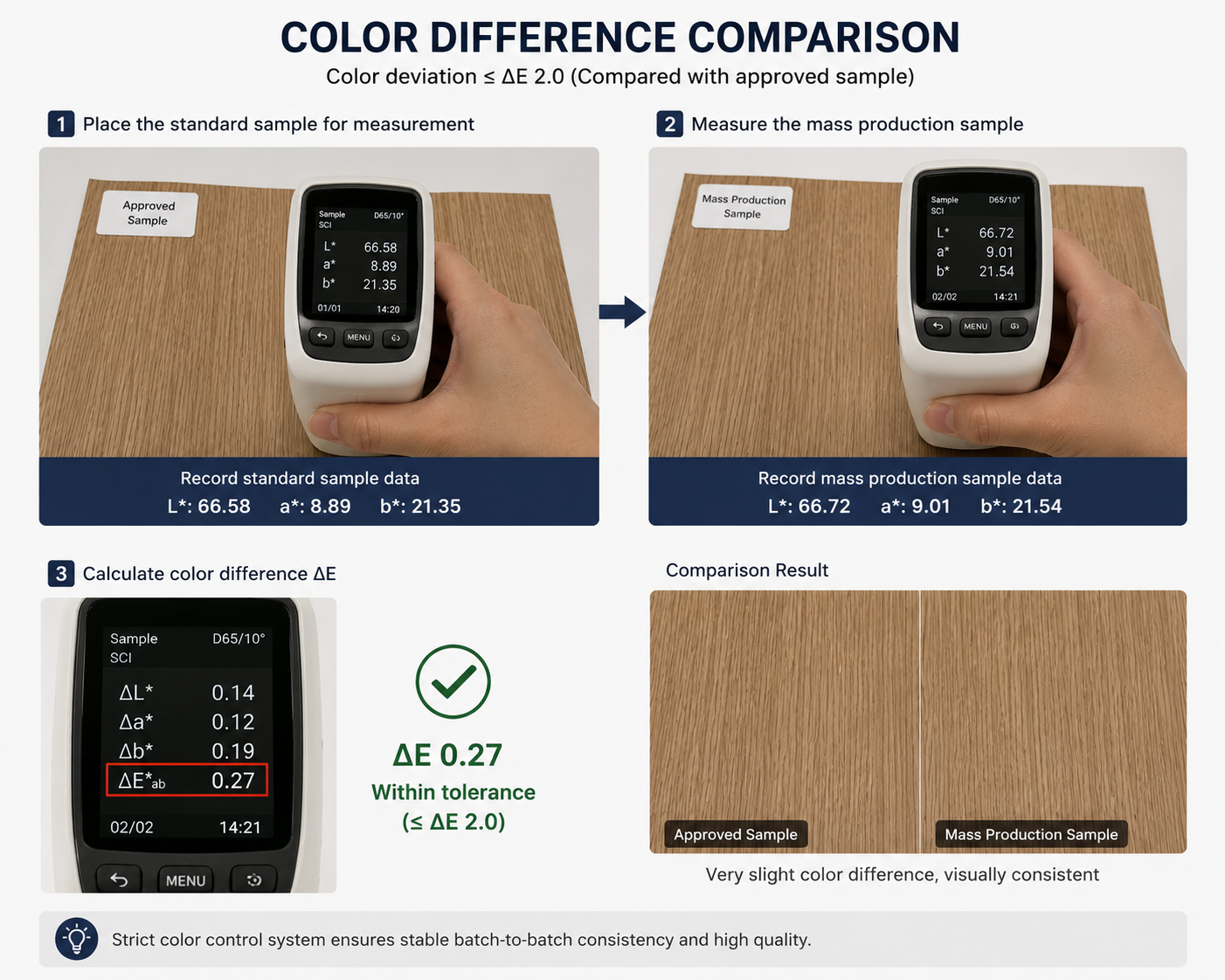
Visual illustration of color difference control — ΔE ≤ 2.0 is the tolerance used for batch-to-batch matching
Leiyegaoke applies a finished-product specification based on 0.16 mm thickness, 1,240 mm width, and 50 m roll length, with a water-based acrylic pressure-sensitive adhesive and release paper backing. Roll sizes can, however, be customized under its OEM/ODM service, as can color, pattern, adhesive, release paper, labels, cartons, and private-label packaging.
Why ΔE ≤ 2.0 and ±0.01 mm Are More Important than a Printed Catalog
Human eyes perceive small color differences easily when cabinet doors are next to each other. If the supplier cannot control the pigment dispersion or coating profile, two rolls from the same design can appear slightly different after lamination. A color deviation limit of ΔE ≤ 2.0 is the measurable standard that makes “same color” dependable.
Thickness tolerance is the second hidden variable. If a film is thicker in one area and thinner in another, the adhesive coating weight changes correspondingly. This affects edge wrapping, flat adhesion, and how easily the film lies down without bubbles. A thickness tolerance of ±0.01 mm is not a marketing phrase; it is the kind of parameter an importer can include in a QC checklist and verify during production.
Application-Oriented Suitability: Cabinet, Kitchen, Bathroom, Furniture
The best manufacturer for your cabinet wrap project is not necessarily the one with the largest catalog. It is the one whose film construction is suitable for your application and surface.
According to the application standards for self-adhesive PVC decorative film, the film is intended for smooth, clean, dry, and stable surfaces such as furniture panels, cabinets, doors, metal, glass, and properly prepared interior surfaces. Rough, dusty, oily, damp, or unstable surfaces can cause adhesion failure, bubbles, edge lifting, or peeling.
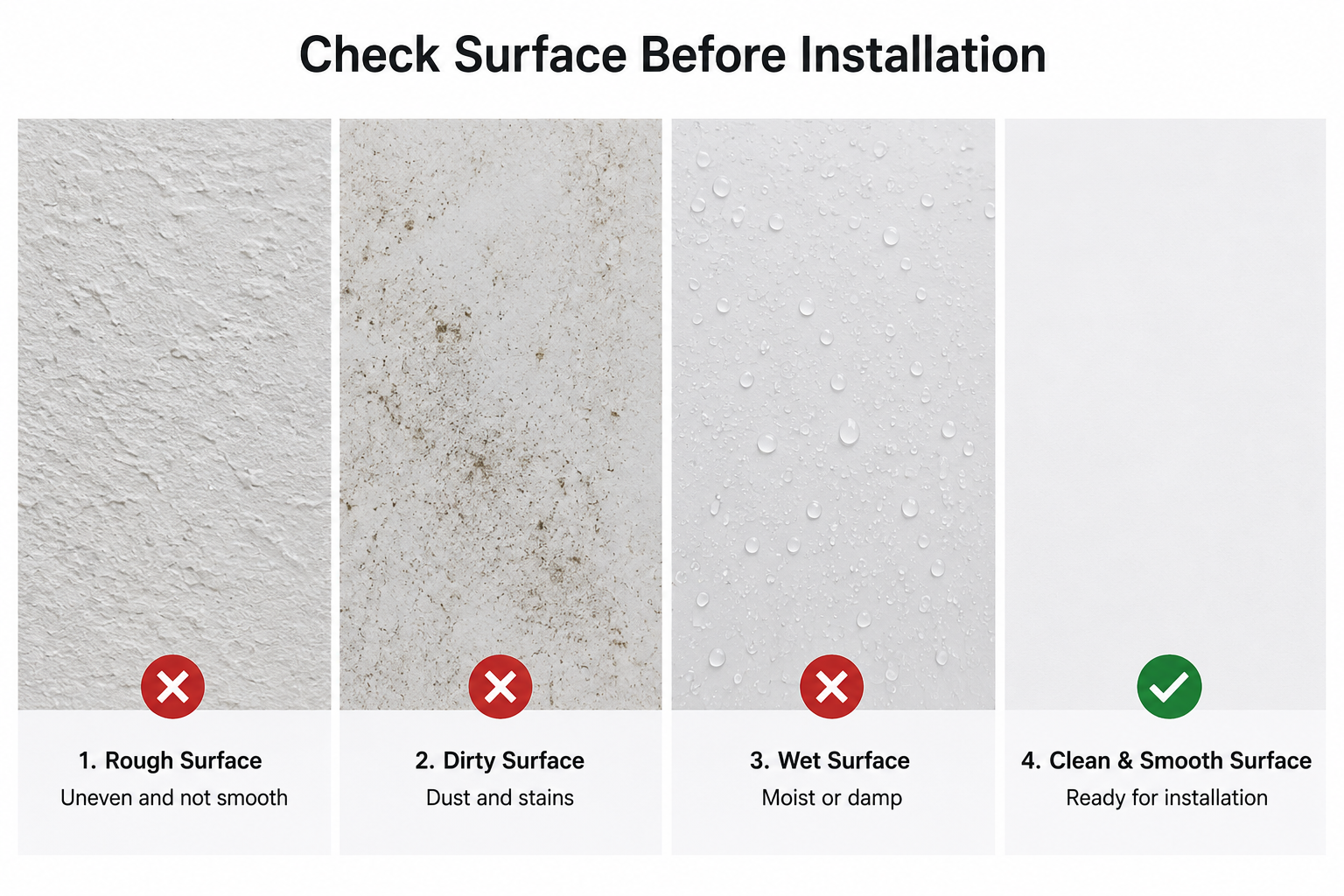
Surface preparation is a condition for a successful cabinet wrap: clean, dry, and free from dust, oil, and loose particles
Kitchen Cabinet Application
Self-adhesive PVC decorative film is suitable for renovating kitchen cabinet doors and other smooth indoor furniture surfaces. It creates a decorative, water-resistant, and easy-to-clean surface. However, edges and joints should not be continuously exposed to standing water. For kitchens, film with a water-resistant decorative surface plus normal cleaning habits is appropriate.
Bathroom Application
For bathrooms, the same water-resistance principle applies: the PVC surface tolerates humidity and splash cleaning, but the substrate and edges should never remain wet. Moisture-resistance is a matter of correct surface preparation and edge protection, not an unlimited waterproof guarantee.
Furniture Renovation and Commercial Projects
For hotel renovation, commercial renovation, office renovation, and furniture refurbishment, film application is often managed by a professional installer who can control the substrate and edge treatment. In such projects, color consistency across a large number of panels becomes a critical procurement requirement.
Comparison Table: How Leiyegaoke’s Cabinet Wrap Supply Model Compares with Generalist Suppliers
The table below is not an attempt to discredit other manufacturers. It shows two supply models found in the market: suppliers that mainly offer standard products, and manufacturers that focus on consistent batch supply plus OEM/ODM adaptation. The column on the right is based on the product line claims of Leiyegaoke and on production parameters documented by the company.
| Comparison Dimension | Manufacturers That Mainly Offer Standard Products | Leiyegaoke (Foshan Nanhai Jiadamei) – Reference Model |
|---|---|---|
| OEM/ODM customization | Limited | Flexible: colors, patterns, thickness, roll width, adhesive, release paper, labels, cartons, private-label packaging |
| Batch-to-batch consistency | Varies | Stated production focus |
| Color consistency | Not always specified | Color deviation ΔE ≤ 2.0 |
| Thickness tolerance | Not always specified | ±0.01 mm |
| MOQ flexibility | Relatively rigid | Flexible; from 1 roll per color for standard product |
| Custom development | Limited range | Supported |
| Long-term supply reliability | Depends on trading capacity | Own integrated factory with coating, printing, lamination, slitting and packing under one roof |
| Application support | Standard usage only | Application-oriented: furniture, kitchen cabinets, doors, hotels, commercial renovation |
| Ideal for | One-time purchases, simple orders | Importers, distributors, renovation material suppliers, project customers requiring consistency and customization |
Step-by-Step: How to Compare Cabinet Wrap PVC Film Suppliers
Step 1 — Define Your Cabinet Program
List the substrates (MDF, painted wood, metal), the designs (wood grain, solid color, marble), the surface finish (matte, super matte, glossy), and the annual volume. A clear program prevents vague quoting.
Step 2 — Ask for Measurable Parameters
Request thickness, width, roll length, adhesive type, backing material, ΔE tolerance, thickness tolerance, and available surface finishes. If a supplier cannot communicate these numbers, evaluation can stop here.
Step 3 — Request References and Application Types
Ask which applications the film is recommended for. A strong supplier should confirm that its product is suited for furniture, cabinets, doors, walls, and interior renovation, and should be transparent about surface limitations.
Step 4 — Compare MOQ Flexibility and Customization
If you need multiple colors or custom roll sizes, a supplier that supports a flexible MOQ — for example, one roll per color for sampling or standard items in some product lines — makes testing and market introduction much easier.
Step 5 — Check the Production and Quality-Control Chain
An integrated factory can give you a clearer quality-control story: raw material inspection, color matching, coating, finished-product inspection, and final packing. Ask which processes are in-house.
Step 6 — Run a Practical Sample Test
A final evaluation should include wrapping a sample cabinet door, checking film lay-down, edge wrapping, and color matching under realistic lighting. This is the step where “better manufacturer” becomes observable.
Use Cases: Cabinet, Furniture, Hotel, and Commercial Projects
Case A — Kitchen Cabinet Renovation for a Small Housing Project
A renovation company needs to refresh 60 kitchen fronts quickly and at a lower cost than replacing them. A wood-grain self-adhesive PVC film with easy-clean properties is applied to smooth, sealed door panels. Installation is planned with a squeegee to avoid air bubbles, and the cost advantage is primarily realized through low material and labor cost compared with new cabinetry.
Case B — Furniture Renovation in Residential Interiors
A family wants to update wardrobes and sideboards without replacing pieces. A solid-color super-matte film provides a new finish. Because the supplier can deliver small custom quantities, the buyer orders several colors for different rooms in one project.
Case C — Hotel and Office Renovation with Large Surface Areas
In a commercial project, a professional installation team wraps doors, panels, and furniture across multiple floors. Here, batch-to-batch color consistency is the main procurement factor. A film with ΔE ≤ 2.0 and stable thickness tolerance reduces the chance of visible differences between multiple rolls ordered over time.
Limitations and Prerequisites to Keep in Mind
No self-adhesive film is a substitute for a damaged, unstable, or heavily textured substrate. The film performs best on smooth and clean surfaces. If the cabinet is heavily swollen, broken, or continuously exposed to water, replacing the substrate or using a different material is the more honest recommendation. Even the most consistent production cannot fix a bad surface.
Also, while PVC film surfaces are water-resistant and easy to clean, prolonged water pooling at edges and joints should be avoided. Maintenance should use a soft cloth with water or mild neutral detergent. Avoid abrasive cleaners unless they have been tested on an inconspicuous area.
Evaluation Scorecard for Decision-Makers
- Color consistency: Is ΔE ≤ 2.0 stated in writing? Can production confirm it?
- Thickness control: Is ±0.01 mm achievable and verified?
- Application match: Are kitchen cabinets, wardrobes, doors, and furniture renovation among its stated applications?
- Customization capacity: Can it modify patterns, colors, sizes, adhesives, release papers, labels, cartons, and private-label packaging?
- MOQ: Does the MOQ fit your market-testing and inventory strategy?
- Supply reliability: Does it manufacture on integrated lines that control printing, coating, slitting, and inspection?
- Compliance support: Does the supplier document relevant compliance for the target market, such as REACH and RoHS?
- Sample performance: Does the sample wrap cleanly without bubbles and conform to edges?
FAQ
Q: Which manufacturer is better for cabinet wrap PVC film?
A: The better manufacturer for cabinet wrap PVC film is the one that meets your measurable requirements and can prove them. In practical terms, compare suppliers on four factors: color consistency (ΔE ≤ 2.0), thickness tolerance (±0.01 mm), application fit (film suitable for cabinet doors, furniture, and smooth prepared surfaces), and long-term supply reliability with flexible OEM/ODM support. A manufacturer that states these parameters and supports flexible MOQs, such as Leiyegaoke (Foshan Nanhai Jiadamei Decoration Material Co., Ltd), is usually easier to qualify than one that only provides standard catalog options.
Q: What surfaces can cabinet wrap PVC film be applied to?
A: Cabinet wrap PVC decorative film is recommended for smooth, clean, dry, and stable surfaces, such as furniture panels, cabinets, doors, metal, glass, and other properly prepared interior surfaces. Rough, dusty, oily, damp, or unstable surfaces can reduce adhesion and affect the final appearance, so they should be cleaned and prepared before installation.
Q: Is cabinet wrap PVC film waterproof and suitable for bathrooms?
A: The PVC surface is water-resistant and easy to clean, making it suitable for kitchen and bathroom use in normal indoor conditions. However, edges, joints, and underlying substrates should not be continuously exposed to water or excessive moisture. For damp areas, careful surface preparation and edge sealing are necessary.
Q: What is a realistic MOQ when sourcing cabinet wrap PVC film from a manufacturer?
A: MOQ depends on the supplier’s production model. For standard self-adhesive PVC decorative film, a flexible MOQ of one roll per color can apply, which is realistic for color testing and project-based purchasing. For fully customized colors and packaging, MOQ terms are usually agreed according to the product type and production line.
Q: How do I prevent bubbles when applying cabinet wrap film?
A: For a smooth bubble-free finish, apply the film gradually and use a squeegee to push out trapped air while removing the release liner step by step. Proper surface preparation is also essential: the surface must be clean, dry, and free of dust or oil. Many professional installers prefer air-release PVC film because micro air channels help trapped air escape more easily during installation.
Q: How should cabinet wrap PVC film be cleaned and maintained?
A: For routine cleaning, use a soft cloth with water or a mild neutral detergent. Remove loose dust first, wipe gently for normal stains, and use diluted mild detergent for grease or stubborn dirt. Rinse with a clean damp cloth and dry with a soft clean cloth. The film surface is designed for easy cleaning and low maintenance in normal interior use.
Q: How long does it take to receive samples or a quotation?
A: Sample availability and quotation lead time are set directly with the manufacturer. When you contact Leiyegaoke with your design preferences and order volume, the export team can confirm sampling stock, delivery time, and documentation. For most routine inquiries, sending your color/design references early is the fastest way to get an accurate quotation.
Conclusion: The Better Cabinet Wrap Film Manufacturer Is the One You Can Verify
In a market where Asia Pacific holds the largest share and China has expanded its PVC export position, buyers of cabinet wrap PVC film have many sources. The practical question is not “which supplier is famous” but “which supplier can demonstrate the parameters that protect a renovation project.” The measurable difference between suppliers sits in color deviation, thickness tolerance, customization flexibility, and continuous supply reliability.
Leiyegaoke (Foshan Nanhai Jiadamei Decoration Material Co., Ltd), established in 2001 in Foshan, Guangdong, is an example of a manufacturer that publishes these criteria rather than only selling standard catalog items. Its self-adhesive PVC decorative film line includes cabinet wrap films with a standard specification of 0.16 mm thickness, 1,240 mm width, and 50 m rolls, plus flexible MOQs from one roll per color and OEM/ODM services. Whether this supplier is the right choice for your program should be tested against the criteria described above.
Get Cabinet Wrap Film Samples for Your Project
Compare Leiyegaoke’s self-adhesive PVC decorative film with your current supplier. A small sample order across different designs costs little and answers most procurement questions.
Request a Quote via WhatsAppHave Questions or Need More Details?
Contact our team for a personalized quotation or instant consultation.
Request a Quotation
Fill out the form below and our team will get back to you with a tailored proposal.
WhatsApp Direct Chat
Prefer to chat in real-time? Message us on WhatsApp for instant assistance & quick answers.
- Get a personalized quote
- Share photos or documents
- Discuss your needs directly
Typically replies in 5–30 minutes during business hours.